Business Process Automation Services: A Buyer’s Scope Test
Business process automation services should turn a defined business task into a bounded job with named inputs, visible limits, and an acceptance artifact. Business process automation, or BPA, covers complex and repetitive processes in IBM’s description. Red Hat defines it as software automating repeatable, multi-step business transactions (IBM; Red Hat). The useful buying question is therefore not “Can this provider transform our operations?” It is “Can both sides describe one job well enough to accept or reject its output?” A sound scope names what goes in, what comes out, what is excluded, and what evidence will prove the result is acceptable. If those elements are missing, the buyer is not comparing bounded automation jobs. The buyer is evaluating an open-ended engagement.
Buyer callout: Ask for the acceptance artifact before discussing the automation method.
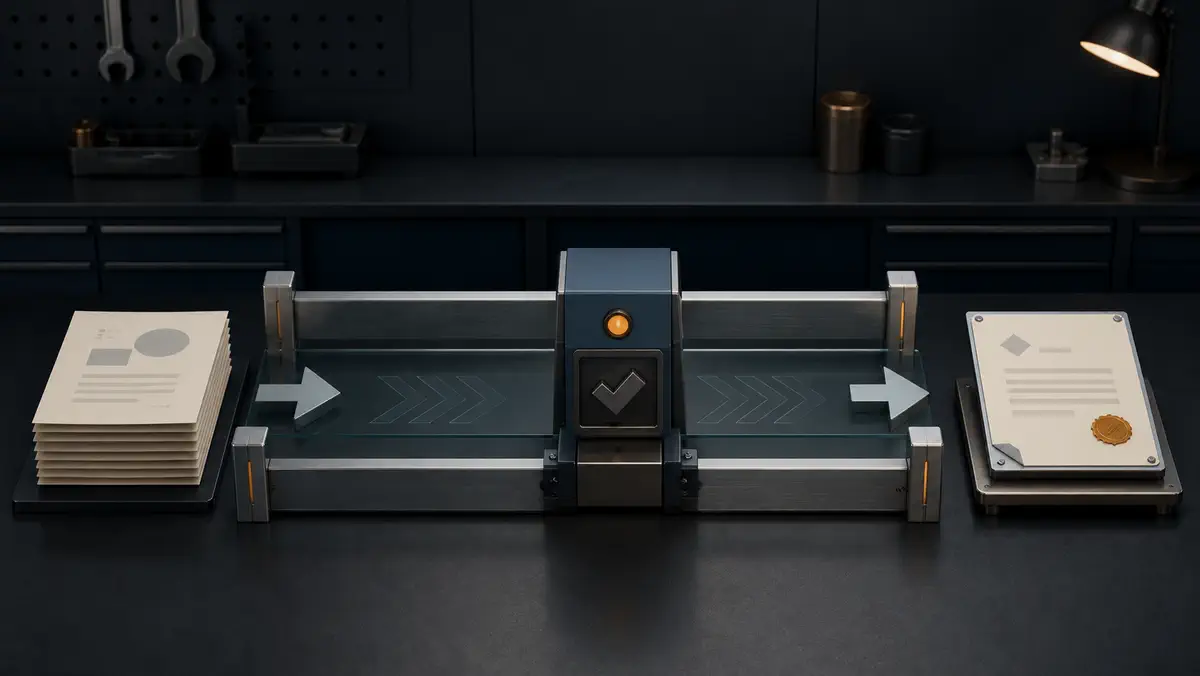
What do business process automation services automate?
IBM describes BPA as a strategy that automates complex and repetitive processes. Its examples include welcome emails, software-access setup, orientation scheduling, and paperwork (IBM). Red Hat’s definition focuses on repeatable, multi-step business transactions (Red Hat). Hyland says BPA uses AI and other automation tools to complete business tasks with minimal human intervention (Hyland).
Those definitions identify a category, but neither source wording defines a purchasable scope (IBM; Red Hat). A buyer still needs to isolate one job from the surrounding business process. The service should automate a named job, not absorb an undefined operational problem.
Use this editorial scope test:
- Name the business task in one sentence, without promising a wider transformation.
- Identify the material the buyer will provide.
- Identify the artifact the run will return.
- State what the job will not decide, change, or publish.
- Define the evidence a reviewer will inspect before acceptance.
“Automate onboarding” is too open for a fixed-scope job. IBM lists welcome emails, software-access setup, orientation scheduling, and paperwork as distinct BPA examples (IBM). A buyer can use that breakdown to ask which named item is in scope. The answer might be one item. It might be several. Each included item still needs its own input, output, limit, and acceptance evidence.
Document work can also be framed as a bounded job. For example, a buyer evaluating invoice extraction can focus on the supplied documents and the returned artifact. A buyer considering spreadsheet cleanup can focus on the supplied workbook and the accepted cleaned file. These links name catalogue jobs. They are not claims about a particular delivery or outcome.
What should a fixed scope contain?
A fixed scope is a shared description between buyer and provider. It makes the job inspectable before anyone debates tools. If a scope cannot show the acceptance boundary, it is not ready to buy as a bounded automation job.
At minimum, require these fields:
- Job statement. Describe the single result requested.
- Inputs. List the files, fields, access, instructions, and examples the buyer will supply.
- Returned artifacts. Name the files or records the buyer will receive.
- Limits. State excluded material, decisions, actions, and destinations.
- Acceptance evidence. Name what a reviewer will inspect and the conditions used to accept the artifact.
- Exception ownership. Identify the person who will decide cases outside the written scope.
- Credential boundary. State whether a key is needed. For the Pitstop model, BYOK applies after acceptance.
The following table is an editorial buying framework. It is not a ranking of providers or a claim about service quality.
| Scope question | Bounded automation job | Vague transformation engagement |
|---|---|---|
| What is being bought? | One named job | A broad operational ambition |
| What does the buyer supply? | An explicit input list | Materials to be determined during the engagement |
| What is returned? | Named artifacts | Outcomes described without a fixed artifact |
| Where does the work stop? | Written exclusions and limits | A boundary left open for discovery |
| How is the result accepted? | Evidence attached to the returned artifact | Approval based on a general impression |
| Who owns exceptions? | A named human owner | Ownership left unresolved |
This distinction does not make one engagement type good and the other bad. It prevents a category error. A broad change programme may be what a buyer wants. It should not be presented as the same purchase as one fixed-scope job.
Scope rule: Every included result needs a corresponding acceptance check. Every excluded decision needs a human owner.
The scope should also keep the tool subordinate to the result. Hyland’s wording includes AI and other automation tools within BPA (Hyland). That supports a tool-neutral buying posture. A buyer can ask for a defined artifact and evidence without prescribing AI for every part of the job.
When is RPA enough?
For this buyer-side framework, treat RPA as enough when the requested behavior can be written as fixed rules and the acceptance evidence can show that those rules were followed. This is an editorial test, not a general definition of RPA. Choose the narrowest tool category that can produce the named artifact within the written limits.
Ask these questions:
- Can the buyer state each permitted action as a fixed rule?
- Can the buyer provide the required inputs in the agreed form?
- Can the output be accepted by checking those rules against the artifact?
- Can all unresolved cases be returned to a named person?
If the answer to each question is yes, the scope does not need an AI claim to sound valuable. If the job asks a system to handle material that cannot be covered by the written rules, the provider must state what AI is expected to do and how its output will be reviewed. Hyland says BPA can use AI and other automation tools to complete business tasks with minimal human intervention (Hyland). That wording permits both AI-assisted and other automation approaches. It does not remove the need for a scope boundary.
Do not let the tool label replace the job statement. “Use RPA” is not a deliverable. “Use AI” is not acceptance evidence. The buyer needs the returned artifact, the applicable check, and a human owner for anything outside the boundary.
What inputs and acceptance evidence should a buyer require?
The input list should be concrete enough for both parties to tell whether the job can begin. The evidence should be concrete enough for a reviewer to accept the returned artifact without inferring unwritten promises. Acceptance evidence is part of the deliverable, not an explanation added after the run.
A buyer can request an evidence file that contains:
- A list of the supplied inputs included in the run.
- A list of the returned artifacts.
- The written acceptance conditions applied to each artifact.
- The cases set aside because they fell outside the scope.
- The reviewer’s acceptance or rejection decision.
This list is an editorial recommendation. It does not prescribe a legal record, compliance process, or universal file format.
For a document-focused job, the buyer can pair this evidence file with the returned document or structured output. The overview of automated document processing provides related context, while a scoped request should still name the actual inputs and artifacts for the job at hand.
The buyer should also decide what happens before credentials are supplied. Pitstop’s stated model is BYOK after acceptance. In scope terms, that means the acceptance boundary must be visible before the buyer provides the key used for the accepted job. It does not imply any wider security or compliance claim.
Acceptance callout: A demo shows behavior. An evidence file shows whether the agreed job produced an acceptable artifact.
What should remain human-owned?
Anything outside the written acceptance boundary should remain human-owned. That is a scope rule, not a claim that one class of system can never perform a task. Automation may return an artifact, but a named person should own exceptions, acceptance, and every decision the scope excludes.
Keep these responsibilities explicit:
- A person approves the job statement and supplied inputs.
- A person decides how to handle material outside the written limits.
- A person accepts or rejects the returned artifact against the stated evidence.
- A person authorizes any later use of credentials under the agreed BYOK boundary.
- A person owns business decisions that were not included in the automation job.
This boundary matters even when the goal is minimal human intervention. Hyland uses that phrase to describe how BPA completes business tasks with AI and other automation tools (Hyland). “Minimal” does not specify which human responsibilities a particular purchase should retain. The written scope must do that work.
The practical buying decision is simple. If you can name the job, inputs, artifact, limits, evidence, and human owners, you have something that can be scoped as a bounded automation job. If you cannot, refine the request before comparing providers.
Request a scoped AI job with the input, artifact, and acceptance boundary you already know. Pitstop is built around catalogue jobs with explicit inputs, artifacts, limits, and BYOK after acceptance.
Frequently asked questions
What does business process automation do?
Business process automation automates complex and repetitive processes in IBM’s description. Red Hat defines BPA as software automating repeatable, multi-step business transactions (IBM; Red Hat). For a buyer, that broad category becomes purchasable only when one job has named inputs, artifacts, limits, and acceptance evidence.
What does a business process automation specialist do?
The supplied sources define BPA, not the role or duties of a business process automation specialist (IBM; Red Hat; Hyland). A buyer should therefore avoid assuming a universal job description. For a fixed-scope purchase, require the responsible specialist to turn the requested job into explicit inputs, returned artifacts, limits, and acceptance evidence. That is an editorial procurement recommendation, not a sourced definition of the occupation.
What is an example of business process automation?
IBM’s examples include welcome emails, software-access setup, orientation scheduling, and paperwork (IBM). A buyer should select the exact example in scope and attach an input, returned artifact, limit, and acceptance check to it. “Onboarding automation” alone does not identify which of IBM’s listed examples the purchase includes.
Will RPA be replaced by AI?
This scope test does not make that prediction. Today’s buying decision can distinguish a fixed-rule scope, BPA as automation of repeatable multi-step business transactions, and BPA that uses AI or other automation tools (Red Hat; Hyland). Choose according to the named job and its acceptance evidence, not a forecast about tool categories.
Written by Tileo, operator of Pitstop.