Report Automation: Scope the Job Before the Tool
Report automation is the automatic generation and delivery of selected information to chosen recipients on a defined schedule, consistent with Jaspersoft's definition. To scope the job, define the source inputs and access, transformation or mapping rules, output artifact and recipients, cadence or trigger, exception handling and human approval, then acceptance tests. This sequence turns “automate this report” into an executable request. It also exposes the real tool requirements before a buyer commits to software: where the data lives, what must happen to it, what must be produced, and what happens when the run cannot finish as specified.
What is reporting automation?
Reporting automation is a workflow that generates and shares specified information with selected people at a pre-decided interval, following the Jaspersoft definition shown in Google's result dated 2026-08-04. The point is not merely to make a dashboard. The job can end in a spreadsheet, slide deck, designed document, dashboard, or another named artifact.
Deloitte describes automated reporting as bringing data-driven insights to users in a timely way without requiring them to seek the information themselves. Its example includes automatically refreshed dashboards with exports to PowerPoint, Microsoft Excel, or other file types (Deloitte).
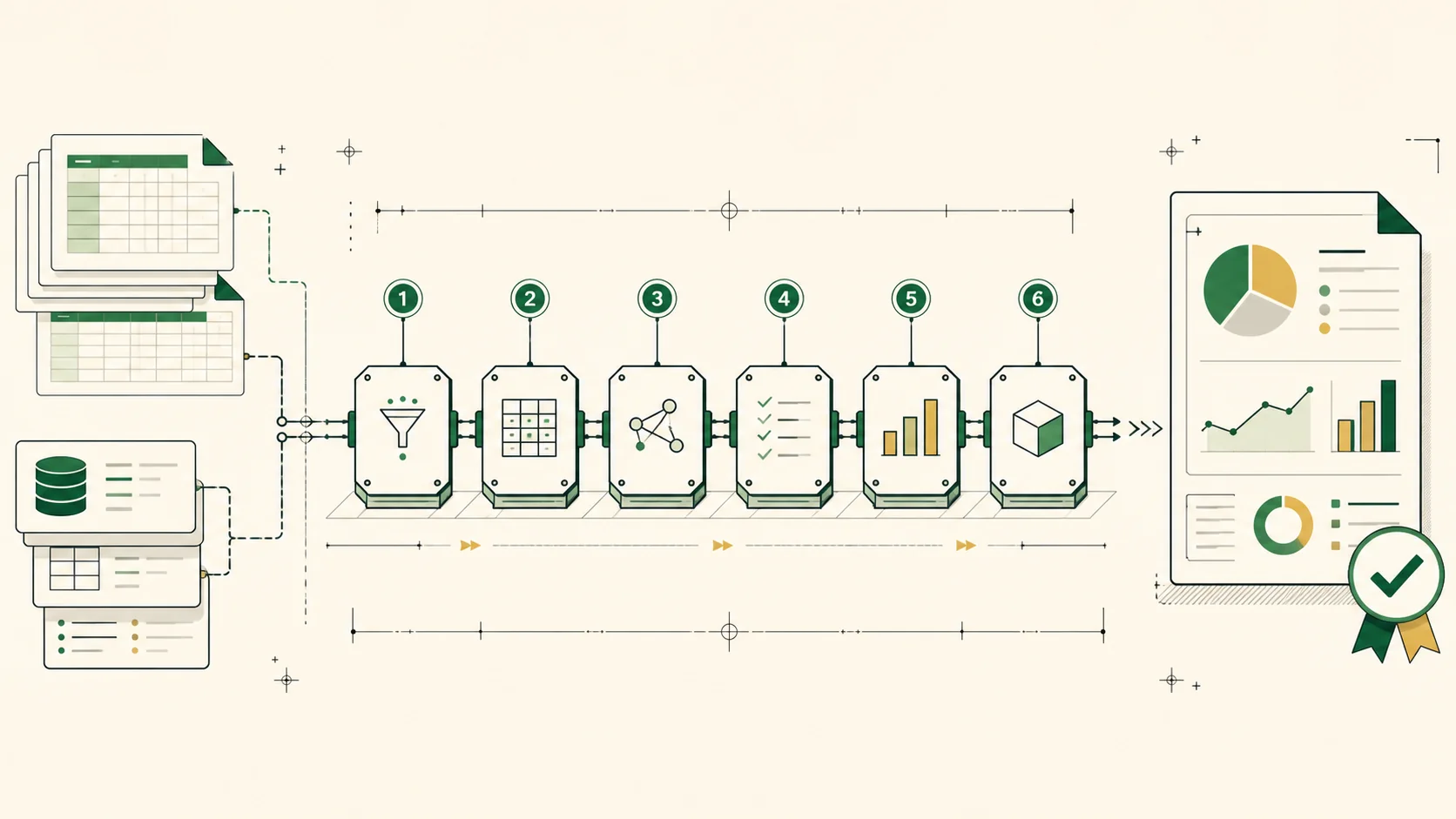
For a fixed-scope job, “automate the report” is still too vague. Use this proposed scoping sequence:
- Define source inputs and access.
- Define transformation and mapping rules.
- Define the output artifact and recipients.
- Define the cadence or trigger.
- Define exception handling and human approval.
- Define acceptance tests.
Each item constrains the build. Together, they describe what one accepted run must do.
What should a report automation template include?
A useful template should make every decision needed for an accepted run visible. It should let an operator inspect the request without guessing what “clean,” “summary,” or “ready” means.
| Scope field | What to specify | Example entry |
|---|---|---|
| Source inputs | Files, systems, sheets, tables, or fields | Uploaded workbook, sheet named Raw Data |
| Access | How the accepted run receives each input | File supplied with the request |
| Transformation rules | Filters, calculations, joins, mappings, and labels | Map source status values to approved display labels |
| Output artifact | Exact deliverable and template | Completed spreadsheet based on the supplied template |
| Recipients | Who receives or reviews the artifact | Named reviewer and named recipient list |
| Cadence or trigger | When a run starts | On approved request submission |
| Exceptions | Conditions that stop or divert the run | Missing required column goes to review |
| Human approval | What must be checked before delivery | Reviewer approves mapped fields |
| Acceptance tests | Observable pass or fail conditions | Required tabs exist and mapped fields match the rules |
Copyable report automation request template
Copy this block and replace every bracketed field:
JOB
Create [report name] for [recipient or use].

SOURCE INPUTS AND ACCESS
- Input: [file, system, sheet, table, or field set]
- Access method: [how the accepted run receives it]
- Required fields: [field names]

TRANSFORMATION AND MAPPING RULES
- Include: [records or conditions]
- Exclude: [records or conditions]
- Calculate: [formula or rule]
- Map: [source value] -> [output value]
- Order or group by: [rule]

OUTPUT ARTIFACT AND RECIPIENTS
- Format: [spreadsheet, slide deck, document, dashboard, or named format]
- Template: [supplied template or exact structure]
- Required sections: [tabs, pages, tables, or charts]
- Recipients: [names or roles]

CADENCE OR TRIGGER
- Start when: [schedule or event]

EXCEPTIONS AND HUMAN APPROVAL
- If [condition], then [stop, flag, or send for review]
- Human approval required for: [named checks]
- Approver: [name or role]

ACCEPTANCE TESTS
- Pass when: [observable condition]
- Pass when: [observable condition]
- Fail when: [observable condition]
If the source data itself needs a defined cleanup pass, scope that separately as spreadsheet cleanup. If the source begins as invoices, specify the extraction boundary before reporting; the invoice extraction service shows how that input job can be isolated.
Ready to turn the template into an executable brief? Request a scoped AI job. Work is scoped per run, and /estimator.html can be used to frame the request without stating a fixed price.
What are practical report automation examples?
The useful unit is not an industry label. It is a precise input-to-artifact job. Here are practical request shapes:
- Turn a supplied workbook into a completed report template using named field mappings, then flag missing required columns for human review.
- Extract approved fields from invoice inputs, apply the supplied mapping rules, and produce a recipient-ready spreadsheet. This can begin with a separately scoped data extraction service.
- Refresh an approved dashboard from defined source inputs, then export the named artifact for listed recipients. Deloitte describes automatically refreshed dashboards with export to PowerPoint, Microsoft Excel, or other file types (Deloitte).
Each example still needs rules. “Create a management report” does not identify the source, mapping, artifact, trigger, exception path, or test. “Populate this supplied workbook template from these named fields, stop when a required column is absent, and send it to the named approver” does.
Can ChatGPT create a report?
Yes, ChatGPT can be assigned a report-creation job when the request supplies the source inputs, transformation rules, target artifact, recipients, trigger, exceptions, approval point, and acceptance tests. The useful question is not whether a model can “make a report.” It is whether the requested run is bounded enough to accept or reject.
Treat the model as one possible component in the job, not as the scope itself. A prompt cannot resolve an undefined mapping rule. It also cannot determine which artifact a recipient expects unless the request says so.
For a proposed model-assisted run, define:
- The exact inputs the model may process.
- The transformations and mappings it must follow.
- The artifact it must return.
- The condition that sends the work to a human approver.
- The acceptance tests applied to the returned artifact.
If an output fails a test, the exception path should say whether the run stops, is flagged, or moves to review. That decision belongs in the request before acceptance.
How do you choose report automation tools?
You do not need to pick a tool first. Start with the job boundary. Source access, transformation rules, output artifact, and exception path determine the tool class.
| Job constraint | Tool capability to inspect |
|---|---|
| Data lives in a named system | Access to that source through the approved method |
| Inputs require mappings or calculations | Rule execution against the defined fields |
| Deliverable is a spreadsheet, deck, document, or dashboard | Generation or export of that exact artifact |
| A run can encounter missing or invalid input | A defined path to stop, flag, or request human approval |
| Delivery follows a schedule or event | Support for the specified cadence or trigger |
| Acceptance depends on observable conditions | A way to inspect the output against those tests |
This answers the “tool first” objection directly. A dashboard platform may fit a refreshed semantic model, while a template-driven document job calls for a different output capability. Microsoft documents scheduled-refresh configuration for Power BI semantic models, which supports that narrow scheduling use case (Microsoft).
Do not let the product category silently rewrite the deliverable. If recipients need a completed spreadsheet or slide deck, “view the dashboard” is not the same acceptance condition. Name the artifact first, then inspect tools against it.
How do you hand off a report automation job?
Hand off the request as a fixed-scope run, not as an open-ended automation ambition. The receiving operator should be able to identify the inputs, apply the rules, produce the artifact, route exceptions, and test the result from the request alone.
Use this acceptance checklist before submission:
- Every source input is named.
- The access method for each input is defined.
- Transformations and mappings are written as explicit rules.
- The output format, template, and required sections are named.
- Recipients are identified.
- The cadence or trigger is stated.
- Exception conditions and the human approver are named.
- Every acceptance test has an observable pass or fail result.
- Any credential or API-key requirement is marked as BYOK after acceptance.
BYOK after acceptance keeps credential requirements visible without making them a prerequisite for describing the job. First agree on the bounded request. Then provide the required key for the accepted run.
The handoff should also preserve scope boundaries. If cleanup, extraction, or an accounting workflow is a separate input job, name it separately. For an adjacent workflow example, see accounting automation.
Frequently asked questions
Is report automation the same as a dashboard?
No. A dashboard can be the output, but the requested artifact may instead be a spreadsheet, slide deck, designed document, or another specified format. Deloitte describes automatically refreshed dashboards and exports to PowerPoint, Microsoft Excel, or other file types (Deloitte).
What information is needed to scope an automated report?
Provide source inputs and access, transformation or mapping rules, the output artifact and recipients, cadence or trigger, exception handling and human approval, and acceptance tests.
Should the tool be selected before writing the request?
No. Write the request first so source access, rule execution, artifact format, trigger, and exception path reveal the required tool capabilities.
What does BYOK after acceptance mean?
It means the job is scoped and accepted before the requester supplies any required API key for the run.
A report request is ready when another operator can execute it and evaluate the artifact without inventing missing rules. Define that boundary, attach the inputs, and make pass or fail visible. Then Request a scoped AI job. Work is scoped per run, and the estimator is available at /estimator.html.
Written by Tileo, operator of Pitstop.