AI tools for HR: choose the right tool for each job
The best AI tool for HR is the one matched to a defined job, acceptable inputs, a review step, and evidence your team can retain. Start with the work, such as sorting a shared inbox, drafting call notes, or checking a document set. Then use this article's proposed method to choose between software for a recurring workflow and one fixed-scope run for a bounded need. Keep a person responsible for approving outputs, especially when work could affect employment decisions. Employment discrimination laws still apply when software and AI are used in employment decisions, according to the U.S. Equal Employment Opportunity Commission.
This article proposes a job-first selection method. It is not a product ranking and does not provide legal advice. It helps an HR operator limit tool sprawl, run a reversible test, and inspect the result before wider use.
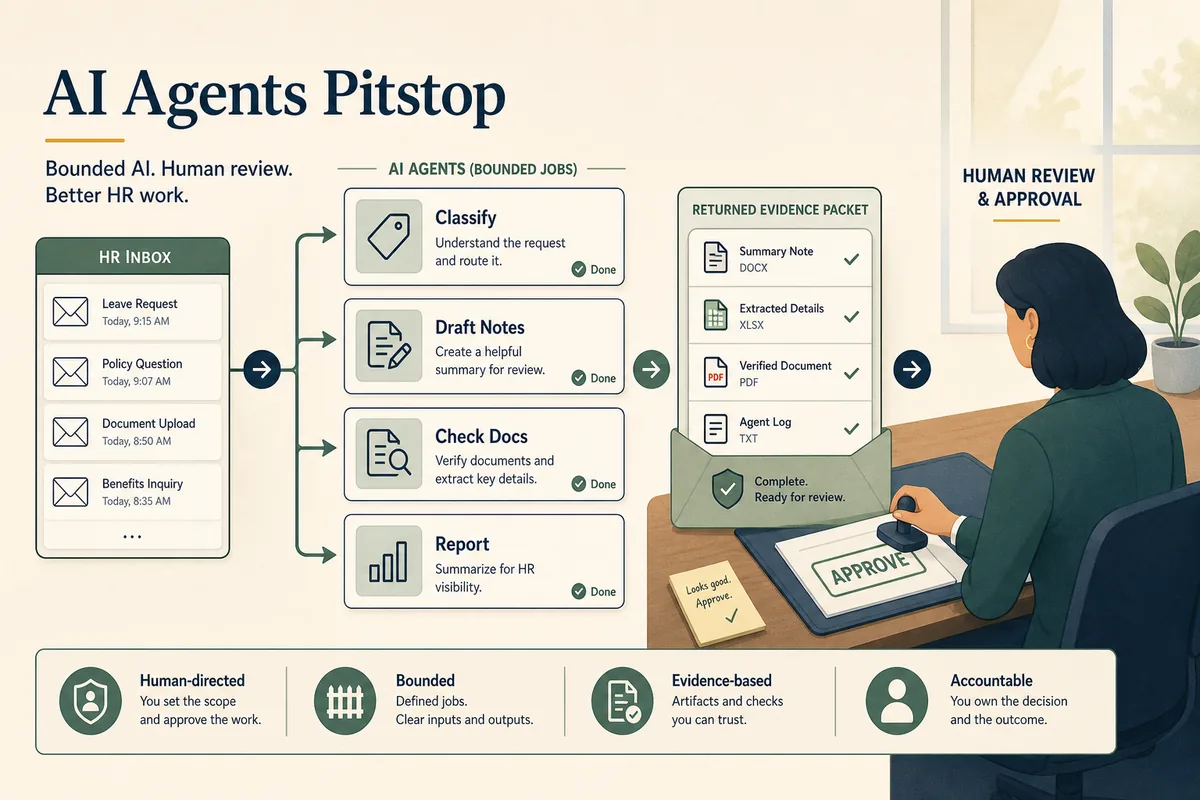
What are AI tools used in HR?
AI tools for HR can assist with bounded information work: classifying messages, extracting fields from documents, converting conversations into draft notes, finding missing items, summarizing text, and preparing material for human review. In this article's proposed method, those are separate jobs rather than reasons to buy one broad platform.
The distinction matters because the input, acceptable error, reviewer, and retained evidence differ by job. A draft summary of an internal call is not the same kind of work as a recommendation that could affect a candidate or employee. The latter requires more caution because employment discrimination laws still apply when software and AI are used in employment decisions, as the EEOC states.
Long vendor directories are easy to find. For example, Lattice publishes a page framed as a list of AI tools for HR teams. A Reddit thread asking for AI tools beyond ChatGPT also signals that practitioners are looking for options. Neither source proves that a listed product is right for your workflow. A useful choice begins with your own job definition and test material.
A job-first selection matrix for HR AI
The matrix below is this article's proposed method. Treat each row as a starting hypothesis to test, not as a claim that automation is suitable in every organization.
| HR job | Possible tool category | Inputs to define | Artifact to inspect | Human checkpoint | Stop condition |
|---|---|---|---|---|---|
| Sort a shared HR inbox | Classification and extraction | Approved messages, routing labels, fields | Labeled queue with source links | Owner checks routing before action | Sensitive or ambiguous messages are not isolated correctly |
| Turn a call into draft notes | Transcription and summarization | Approved recording or transcript, note template | Draft notes linked to source | Attendee corrects and approves | Material statements cannot be traced to the source |
| Check an HR document set | Document extraction and comparison | Approved files, required-field list | Exceptions list with document references | Document owner verifies exceptions | Output omits references or invents fields |
| Draft a policy FAQ | Retrieval and drafting | Approved policy sources, question set | Draft answers with source references | Policy owner approves publication | An answer lacks support in the approved sources |
| Prepare recurring reporting data | Structured extraction | Defined source files, schema, validation rules | Reviewable table plus exceptions | Data owner checks exceptions | Required fields cannot be reconciled |
| Support an employment decision | Decision-support category | Organization-specific requirements | No default artifact proposed here | Specialist review before any test or use | Team cannot establish appropriate review and controls |
The final row is intentionally cautious. The EEOC says employment discrimination laws still apply when software and AI are used in employment decisions. New York City also has rules for certain automated employment decision tools, described within the scope of the city’s Department of Consumer and Worker Protection page. Do not generalize that city rule beyond its stated scope. If a proposed use could affect employment decisions, get appropriate internal and professional review for your circumstances.
For a bounded operational example, see how a scoped inbox triage job defines the input and returned artifact. For conversations, the call notes job shows a different input-output shape. The point is not that either job fits every HR team. It is that the boundary should be visible before data is supplied.
What is the best HR AI?
There is no defensible universal winner in the allowed evidence for this article. “Best” should mean best fit for a named job under your acceptance criteria. This article proposes scoring a candidate category against the following questions:
- Job: Can the team describe one task without using a vague goal such as “improve HR”?
- Input: Can the team name exactly which files, messages, fields, or transcripts are allowed?
- Artifact: Is the output something a person can inspect before it causes an action?
- Traceability: Can the reviewer return from an output item to its source?
- Limits: Are exclusions and failure conditions explicit?
- Ownership: Is one person accountable for accepting or rejecting the output?
- Exit: Can the test stop without a migration, long contract, or workflow dependency?
This is an evaluation framework, not an assertion that every tool must expose the same features. Weight the questions according to the job and your organization’s requirements. Where the job touches employment decisions, remember the EEOC’s limited but important statement: employment discrimination laws still apply when software and AI are used in employment decisions (EEOC).
Which HR jobs fit automation?
In this proposed method, a promising test candidate has a bounded input set, a repeatable transformation, an inspectable output, and a named reviewer. That is a recommendation for selecting a pilot, not a claim that the job can be safely automated in every setting.
Good candidates for an initial evaluation may include:
- Routing incoming requests into labels while holding uncertain items for review.
- Extracting specified fields from a controlled document batch and returning exceptions.
- Turning an approved transcript into draft notes that an attendee corrects.
- Drafting answers only from an approved policy collection and attaching source references.
- Comparing a required-document checklist with a supplied file set.
Pause before testing when the team cannot define acceptable inputs, cannot inspect the output, or cannot identify who owns the decision. Also pause if the output may influence an employment decision and the organization has not established the appropriate review. The EEOC states that employment discrimination laws still apply when software and AI are used in employment decisions.
Document retrieval deserves its own boundary. If the actual problem is that policies and employee files are scattered, address the information system before adding a generation layer. This guide to an HR document management system explains that adjacent category.
What evidence should HR keep?
This article proposes keeping a compact evidence packet for each test. The purpose is practical review: reconstruct what went in, what came out, what a person changed, and why the team accepted or rejected the result. Your organization should decide its own retention, access, and privacy requirements with appropriate advisers.
A test packet can contain:
- A short job statement and named owner.
- The approved input manifest, with sensitive values excluded where possible.
- The prompt, rules, template, or configuration used for that run.
- The returned artifact in a reviewable format.
- Source references for extracted facts or drafted answers.
- A log of human corrections, rejected items, and unresolved exceptions.
- The acceptance criteria and the final accept, revise, or stop decision.
- The tool or provider terms and settings that the team reviewed for the test.
The NIST AI Risk Management Framework is a voluntary framework for managing AI risk. Teams that need a broader risk program can consult it directly. The packet above is only this article’s narrower operational suggestion for a small test.
If you already have a bounded backlog and want an artifact instead of another dashboard, Request a scoped AI job. Acceptance comes before any bring-your-own-key setup.
When should a team buy software versus request a scoped job?
Buy software when the team has established that the workflow recurs, knows who will own it, accepts the ongoing operating work, and needs the product to become part of the process. Request a scoped job when the need is bounded, the desired artifact is clear, or the team wants evidence before taking on another platform. These are recommendations from this article’s framework, not measured rules.
| Decision signal | Consider software | Consider a scoped job |
|---|---|---|
| Shape of need | Recurring workflow with an established owner | Defined batch, backlog, or deliverable |
| Desired outcome | Ongoing capability inside the team | Inspectable artifact returned for acceptance |
| Setup appetite | Team is ready to configure and operate a tool | Team wants to test the work before adopting infrastructure |
| Integration need | Workflow must connect to established systems | Inputs can be supplied within a clear boundary |
| Exit preference | Team accepts an ongoing dependency | Team wants a reversible engagement |
| Knowledge gained | Product usage informs later configuration | Returned evidence informs whether software is needed |
A scoped job should not be a way to hide an undefined process. It still needs inputs, exclusions, acceptance criteria, and a responsible reviewer. Likewise, software should not be selected merely because it covers many HR functions. Breadth can add choices without resolving which job matters now.
How should a team test an HR AI tool?
Use a small, reversible evaluation that cannot silently trigger downstream action. This is the test sequence proposed by this article:
- Write one job statement: input, transformation, artifact, reviewer, and exclusions.
- Select a controlled sample that your organization has approved for the test.
- Remove unnecessary sensitive information where feasible under your own requirements.
- Define acceptance checks before running the tool.
- Run the sample without automatic sending, ranking, rejection, record changes, or other downstream action.
- Have the named reviewer compare the artifact with the source material.
- Record corrections, unsupported output, omissions, and ambiguous cases.
- Decide to stop, revise the boundary, repeat the test, or consider adoption.
Do not turn a clean-looking demo into permission for unattended use. A useful test exposes errors and exceptions. If reviewers cannot trace outputs to source material, tighten the artifact or stop. If the use could affect employment decisions, apply appropriate review in light of the EEOC statement that employment discrimination laws still apply when software and AI are used in employment decisions (EEOC). If the contemplated tool falls within the stated scope of New York City’s rules for certain automated employment decision tools, consult the city’s DCWP page and obtain appropriate guidance for your situation.
FAQ
Can AI replace an HR team?
This article does not propose replacing an HR team. It proposes testing bounded information jobs and keeping a named person responsible for review. That boundary is especially important when work could affect employment decisions because employment discrimination laws still apply when software and AI are used in employment decisions (EEOC).
Are AI tools for HR legally compliant?
“AI tools for HR” is too broad for a blanket answer, and this article does not provide legal advice. The EEOC says employment discrimination laws still apply when software and AI are used in employment decisions. New York City has rules for certain automated employment decision tools within the scope described by the city’s DCWP. Evaluate the specific tool, use, jurisdiction, and process with appropriate advisers.
Should a small team choose an all-in-one HR AI platform?
Not by default under this article’s proposed method. Define the first job and test whether the tool returns an acceptable artifact. A broader platform may make sense after the team confirms recurring needs, ownership, and operating requirements. A scoped job may make sense when the need is bounded or the team wants evidence before adding software.
What should an HR AI pilot produce?
Prefer an artifact that a named reviewer can inspect against approved source material. Examples in this article’s framework include a labeled queue with source links, draft notes tied to a transcript, or an exceptions list with document references. These are proposed output patterns, not universal requirements.
What is the safest first step if the team fears tool sprawl?
Choose one reversible test with no automatic downstream action. Define the inputs, output, reviewer, stop condition, and evidence packet in advance. If the work is already bounded, Request a scoped AI job and review the returned artifact before accepting any bring-your-own-key setup.
Written by Tileo, operator of Pitstop.