Recruiting automation tools: choose the work before the software
By Loïc Guyon, operator of Pitstop · Updated · 9 min read
On this page
- What the supplied sources can and cannot prove
- Which small-team tools belong on a real shortlist?
- How should a small team choose?
- When does a scoped recruiting artifact fit better?
- How do software, an artifact, and human review divide the work?
- What are the best automation tools for recruitment?
- What are the top 10 recruiting tools?
- What should remain a human decision?
Recruiting automation tools cover distinct jobs: sourcing, screening, shared applicant records, scheduling, and interview notes. A small team should shortlist products only after naming its recurring bottleneck, who will operate the tool, how pricing changes with logins, whether a price is visible, and whether the team can begin without a sales call. The supplied extracts support a compact shortlist, not a universal ranking. They identify Juicebox for sourcing, Truffle for screening, Zoho Recruit, Manatal, and Workable for shared recruiting workflows, GoodTime for scheduling, and Metaview for interview notes (Truffle; SelectSoftware Reviews). Keep role requirements, candidate assessment, interview judgment, and every hiring decision with named people.
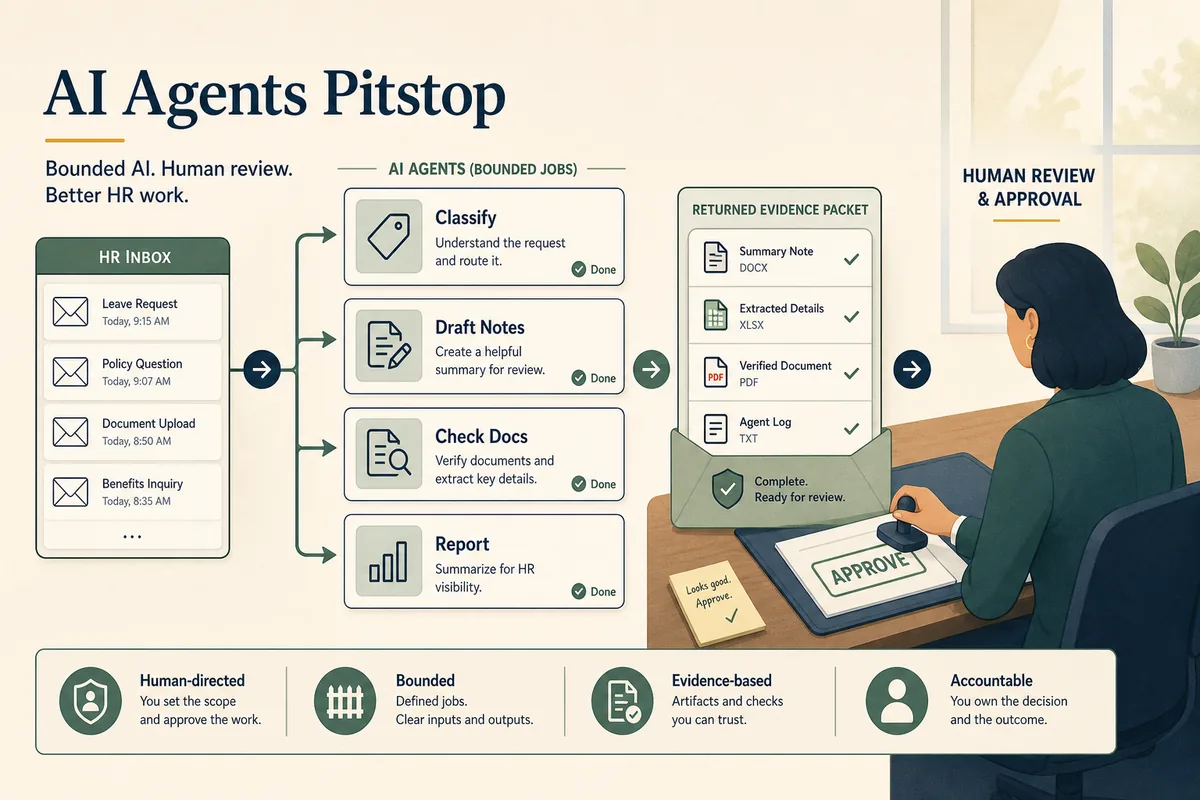
Buy a workflow when the work must continue. Commission an artifact when the work ends at an accepted output. Keep the hiring decision human.
What the supplied sources can and cannot prove
The packet supports product names, listed functions, and stated pricing conditions. It does not prove a universal winner or confirm that every listed term is still available.
One extract comes from Truffle, which sells a product included in its own comparison. The other comes from SelectSoftware Reviews, which says that it is reader-supported and may earn fees from clicks (Truffle; SelectSoftware Reviews). Pitstop did not test these products. Check current terms with each vendor before buying.
The extracts also disagree in emphasis. Truffle frames the choice around a small team where one person may run hiring and whether a sales call is needed. SelectSoftware Reviews weighs automation coverage, candidate experience, reporting, and setup management (Truffle; SelectSoftware Reviews). That difference is useful. It prevents a broad feature list from replacing your own operating constraints.
Which small-team tools belong on a real shortlist?
Shortlist by recruiting task, then use pricing shape and buying access to remove products that do not fit how your team operates.
| Task | Tool and supported capability | Decision-useful constraint |
|---|---|---|
| Sourcing and outreach | Juicebox supports natural-language search, candidate ranking, sourcing agents, and outreach sequences (Truffle). | The supplied extract lists a free plan without contact or export credits, then a Starter plan at $99 per user each month when billed annually or $119 month to month. It lists sourcing agents as a $199 per agent monthly add-on to a paid plan (Truffle). |
| Application and asynchronous screening | Truffle combines resume screening, one-way video interviews, assessments, employer-defined match criteria, transcripts, and summaries (Truffle). | The vendor extract states plans start at $49 per month on a credit model. It states that a 7-day trial includes 30 credits and requires no credit card (Truffle). |
| Shared ATS workflow | Zoho Recruit is listed with workflow automation and AI matching. Manatal is listed with AI matching and social enrichment (Truffle). | Zoho Recruit has a listed free tier and a Standard plan at $25 per recruiter each month when billed annually. Manatal is listed at $15 per user each month when billed annually (Truffle). |
| Shared ATS workflow with a flat plan | Workable is listed with AI screening, scheduling, offer letters, and a metered Workable Agent add-on (Truffle). | The listed starting price is $299 per month, flat rather than based on headcount. The Workable Agent uses metered AI credits and is not included in the base plan (Truffle). |
| Complex interview scheduling | GoodTime is listed for automated scheduling, interviewer load balancing, and candidate reminders by SMS and WhatsApp (Truffle). | The listed pricing requires contacting sales and is based on candidate volume rather than seats. SelectSoftware Reviews also lists custom pricing and no free trial (Truffle; SelectSoftware Reviews). |
| Interview notes | Metaview is listed with an AI notetaker, structured scorecards, and write-back to Greenhouse, Lever, and Ashby (Truffle). | Pricing for the interview-notes use case is not stated in the supplied source. The extract says that the platform charges for the agents used, but the only listed starting price is for sourcing at $100 per user each month (Truffle). |
This is not a top list. Each row answers a different task. The sources do not support a quality ranking across the rows, and a price for one pricing unit does not establish the total cost for your team.
How should a small team choose?
Model the way your team buys and operates the tool before comparing feature depth.
- Name one recurring task. Sourcing, screening, ATS records, scheduling, and interview notes require different products in the supplied extracts (Truffle).
- Name the operator. If one person runs hiring, record that fact before pricing the shortlist. The Truffle extract explicitly uses this small-team condition (Truffle).
- Write down the pricing unit. Manatal is listed per user, Zoho Recruit per recruiter, Juicebox per user, GoodTime by candidate volume, and Workable as a flat plan rather than a headcount-based price (Truffle). These units are not interchangeable.
- Price the logins you actually need. A per-user or per-recruiter price creates an incremental listed charge when another paid login is added. A flat listed plan does not use that same unit (Truffle). The extract does not state taxes, implementation fees, or negotiated terms.
- Separate visible pricing from immediate access. The extract places Truffle, Zoho Recruit, Manatal, Workable, and Juicebox among products that publish a price. It places GoodTime among products that require a sales conversation (Truffle). A visible price alone does not prove that setup is self-service.
- Record the start condition. The supplied source explicitly states a no-card trial for Truffle and a free plan for Juicebox. It does not state a no-call start for Zoho Recruit, Manatal, or Workable, so do not assume one (Truffle).
- Name the human checkpoint. Software can present records or evidence. A named person still interprets the evidence, decides who advances, and makes the hiring decision.
A one-person hiring function may care more about the first usable login and a visible entry price. A team that needs several logins must compare the stated pricing units. Both choices follow from the operator count, not from a generic product score.
When does a scoped recruiting artifact fit better?
A scoped artifact fits when the work has approved source material, one defined output, one reviewer, and a firm stopping point.
Here is one inspectable scope. It is an example of a Pitstop job boundary, not recruiting software and not a product claim:
- Inputs: the approved role criteria, the supplied interview transcript, and the interviewer's supplied notes.
- Output: one structured interview-notes document that maps each note to the supplied material and marks unanswered criteria.
- Reviewer: the named interview lead accepts or rejects the document after checking it against the transcript and notes.
- Limits: the artifact does not source candidates, contact candidates, update an ATS, score or rank people, recommend advancement, or make a hiring decision.
The output is inspectable because the reviewer can trace it to the named inputs. The job ends when the reviewer accepts or rejects that document. If the same note-taking step must run inside every live interview and write back to a shared system, the recurring software category is the closer fit. The supplied source places Metaview in that interview-intelligence category (Truffle).
Pitstop sells scoped AI job runs. It does not sell recruiting software. A scoped job can sit beside an ATS, but it does not become the shared hiring system and it does not take control of candidate communication. For an executive search firm, the executive search page shows that boundary on a live mandate: agents draft the first approach to each candidate and the follow-ups, and nothing reaches a candidate or a client without a partner’s approval.
How do software, an artifact, and human review divide the work?
Software carries a recurring workflow. A scoped artifact returns a bounded output. People remain accountable for candidate decisions.
| Recruiting need | Software boundary | Scoped artifact boundary | Human boundary |
|---|---|---|---|
| Candidate sourcing | A sourcing product can support recurring discovery and outreach. Juicebox is listed for those functions (Truffle). | A closed research file is possible only when the approved sources and output are explicit. | A person checks relevance and decides whether to contact anyone. |
| Application screening | A screening product can organize recurring resume, response, or assessment review. Truffle is listed for these functions (Truffle). | A review packet can organize supplied evidence without ranking candidates. | A person evaluates the evidence and decides who advances. |
| Interview scheduling | A scheduling product can coordinate calendars and reminders. GoodTime is listed for those functions (Truffle). | A fixed exception list can report conflicts found in supplied scheduling data. | People approve availability and resolve changes. |
| Interview notes | Interview-intelligence software can support recurring notes and ATS write-back. Metaview is listed for those functions (Truffle). | One structured notes document can be produced from a fixed transcript and supplied notes. | Interviewers verify the record and own the assessment. |
| Hiring decision | Software is not the accountable decision owner. | The artifact does not contain an autonomous hire, reject, rank, or advance decision. | A named person makes every candidate decision. |
What are the best automation tools for recruitment?
The supplied sources support a task-based shortlist, not one best tool.
For sourcing, the packet provides usable details for Juicebox. For application and asynchronous screening, it provides details for Truffle. For a shared ATS workflow with published entry pricing, it provides details for Zoho Recruit, Manatal, and Workable. For complex scheduling, it identifies GoodTime but states that pricing requires a sales conversation. For interview notes, it identifies Metaview but does not state the price for that use case (Truffle; SelectSoftware Reviews).
That is enough to build a first call sheet. It is not enough to declare a winner. Confirm the current price, included usage, setup path, data handling, and contract terms with a vendor before adopting a product. Those fields are not fully stated in the supplied extracts.
What are the top 10 recruiting tools?
The packet does not support a universal top-ten ranking, and this guide does not invent one.
The Truffle extract lists products across sourcing, screening, ATS, scheduling, and interview-intelligence work. SelectSoftware Reviews uses a different selection method and highlights products for different team sizes and tasks (Truffle; SelectSoftware Reviews). Putting all of them into one ordered list would compare unlike jobs.
Use the shorter question instead: which product fits the named task, operator count, pricing unit, buying path, and human checkpoint? If the work ends with one accepted document, define the scoped artifact instead of buying a permanent workflow.
What should remain a human decision?
People should own the role requirements, the interpretation of candidate evidence, the interview assessment, and the hiring decision.
The supplied Truffle guide draws a similar product boundary: software can handle mechanical work and surface evidence, while the hire remains a human decision (Truffle). That principle also keeps the buying brief clear. Software can carry a workflow. A scoped job can return an artifact. Neither becomes the accountable decision-maker.
- A role owner approves what the team is hiring for.
- A reviewer checks the software output or scoped artifact against its source material.
- Interviewers record and stand behind their assessment.
- A named person makes the hiring decision.
If the recurring step needs a shared operating home, shortlist the relevant software category. If the need is one closed output, request a scoped AI job with the input set, artifact, and reviewer already named.
Written by Loïc Guyon, operator of Pitstop.