AI Acceptable Use Policy for Professional Services
By Loïc Guyon, operator of Pitstop · Updated · 8 min read
On this page
- What should an AI acceptable use policy accomplish?
- What copyable AI acceptable use policy can a small firm adopt?
- How should your firm adopt this policy?
- What information should AI never receive by default?
- Who must approve each type of AI-assisted work?
- What must a human reviewer verify before approval?
- What evidence should the firm retain?
- What should happen after an AI-related incident?
- When should the policy change?
- How can a firm put this policy into practice?
An AI acceptable use policy for a professional services firm should state which tools are approved, what data may be entered, which uses are permitted or prohibited, who owns each output, and what evidence must be retained. To make the policy usable, name four operating fields: approved tools, admissible data, allowed and disallowed uses, and the human owner responsible for each output and its record. Treat every client-facing item, including a mandate, client update, outreach message, or proposal, as a draft until a named person reviews and approves the exact text. Record that approver and the decision so the firm can see how the policy was applied in practice.
What should an AI acceptable use policy accomplish?
A useful policy turns broad caution into choices a team can apply to client work. It sets rules for drafts, restricted inputs, banned acts, review steps, owners, saved records, and incident response.
The NIST AI Risk Management Framework 1.0 says its cross-cutting GOVERN function calls for policies, processes, procedures, and practices with clear roles and duties. The NIST Generative AI Profile says its working group focused on four primary considerations: governance, content provenance, pre-deployment testing, and incident disclosure. For a compact operating model that connects these rules to owners, thresholds, and retained evidence, see this AI governance framework for small firms.
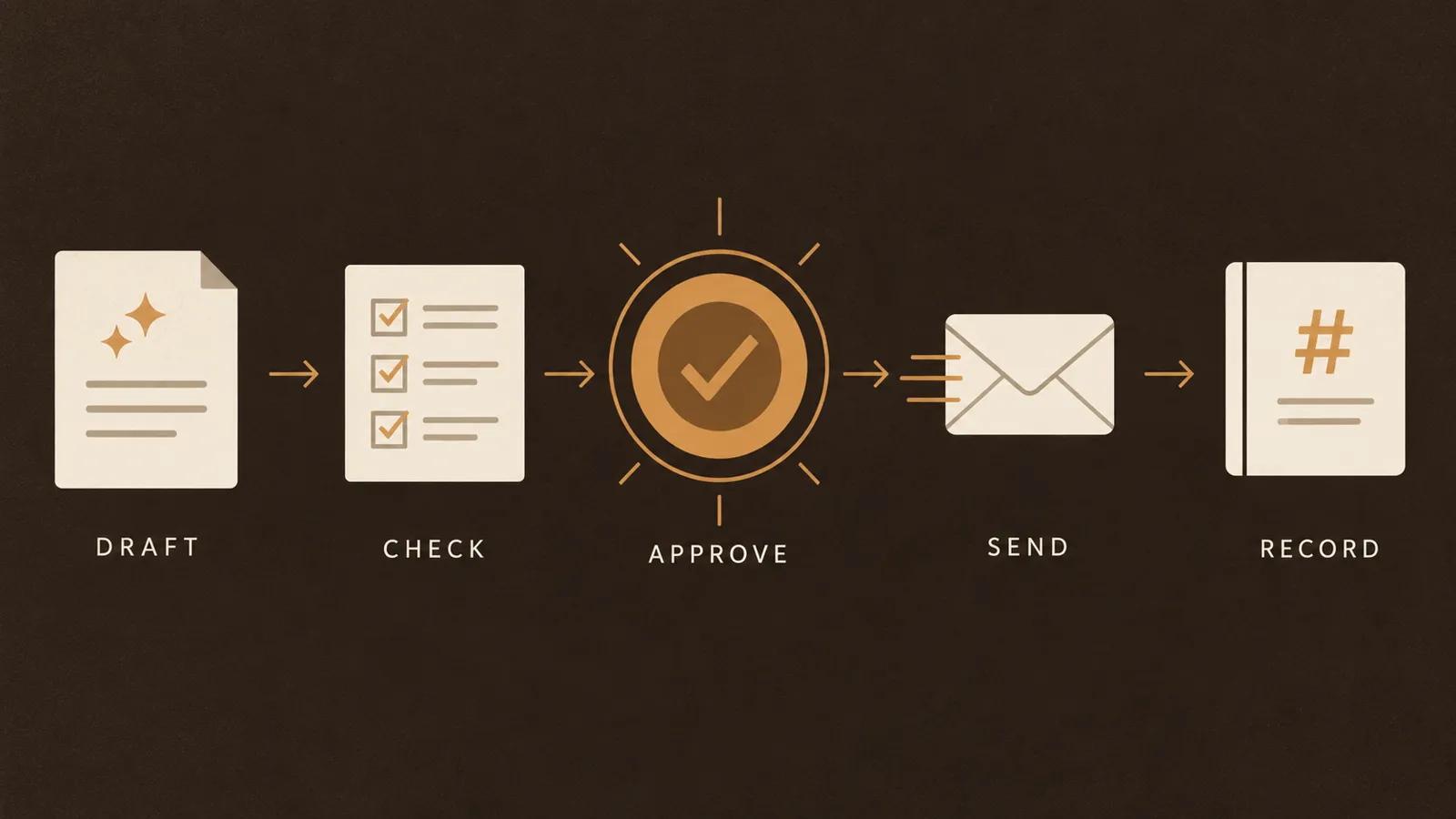
AI can prepare work. A named person decides what leaves the firm.
What copyable AI acceptable use policy can a small firm adopt?
Replace bracketed roles with names before you adopt the policy. Link the rules to tools, engagements, and review paths that the firm has approved.
1. Purpose and scope
This policy covers employees, contractors, and AI agents that work on firm systems or client work. It defines approved AI uses, protected inputs, banned acts, human review, approval owners, and the records the firm keeps.
2. Approved uses
Subject to the input rules below, the firm permits AI for:
- brainstorming;
- summaries of non-restricted material;
- drafts of internal working text; and
- preparing client-facing text that remains pending human approval.
AI output is a draft until the required reviewer approves the exact content.
3. Prohibited inputs
By default, users and agents must not give an AI tool any of these inputs: credentials, secrets, unrestricted personal data, client-confidential material, privileged material, or contractual data. They may give it such material only if the firm has explicitly approved both the tool and the engagement for that material.
Without both approvals, do not submit the material.
4. Prohibited actions
Employees, contractors, and AI agents must not:
- impersonate another person;
- send external messages without the required human approval;
- delegate final professional judgment to AI;
- invent citations or evidence; or
- bypass a client’s tool restrictions.
A polished draft does not remove the need for review, and an urgent request does not remove the need for approval.
5. Verification and approval
Before approval, the reviewer checks the draft’s facts, source links, recipients, tone, confidentiality, and attachments. The approval covers only the exact text and materials reviewed. A material edit needs a new approval.
6. Incident response
Stop the workflow in any of these cases: restricted material enters an unapproved tool, unapproved content leaves the firm, or an AI-supported output causes a problem for a recipient. Keep the prompt, output, and approval record. Notify [named policy owner]. Correct the effect on the recipient when appropriate.
7. Ownership and accountability
[Named partner] owns this policy. [Operations lead] keeps the list of approved tools and review paths. Each sender remains responsible for content that leaves under that person’s name.
8. Policy review trigger
Revise this policy after a tool, client term, workflow, or material incident changes. Save the approved revision. Share the changed rule with affected employees, contractors, and agent owners.
How should your firm adopt this policy?
Use this adoption record to define the policy for each tool and engagement before your firm puts it into practice.
| Approved tool and purpose | [Tool: ___] [Approved purpose: ___] |
|---|---|
| Admissible data | [Exact data classes permitted for this tool and engagement: ___] |
| Permitted and prohibited uses | [Permitted preparation: ___] [Prohibited action: ___] |
| Human owner and evidence | [Approver for mandates, client updates, outreach, and proposals: ___] [Exact approved content: ___] [Decision-maker identity: ___] [Decision time: ___] |
- Complete all four fields.
- Test one real workflow from its input through the human decision.
- Correct any gaps before expanding its use.
What information should AI never receive by default?
The default banned-input rule covers credentials, secrets, unrestricted personal data, client-confidential material, privileged material, and contractual data. An exception applies only when the firm has explicitly approved both the tool and the engagement for that material.
Approval for a tool alone does not cover every client engagement or every type of information. The approved-tool record and the engagement’s terms must allow the same use. Only then may anyone submit restricted material.
Who must approve each type of AI-assisted work?
The firm should name roles before the policy goes live. This model gives internal work a clear route. It keeps exact-text approval for anything that may leave the firm.
Approval of an idea, outline, or earlier version does not approve the final text.
| Work product | AI may draft? | Required reviewer | May leave only after exact-text approval? | Record retained |
|---|---|---|---|---|
| Internal note | Yes | Author | Not applicable while internal | Final note and source links |
| Meeting summary (AI notetaker guide) | Yes, using permitted inputs | Meeting owner | Yes, if shared externally | Approved summary and approval |
| Client update | Yes | Engagement lead | Yes | Exact approved text and approval |
| Candidate outreach | Yes | Responsible consultant | Yes | Exact approved text, recipient, and approval |
| Proposal | Yes | Named partner | Yes | Final proposal, sources, and approval |
| Invoice or financial communication | Yes | Finance owner | Yes | Final communication, attachments, and approval |
| Legal or regulatory statement | Yes, as working text | Named partner and qualified reviewer | Yes | Final statement, source links, and approvals |
What must a human reviewer verify before approval?
The reviewer checks the exact draft and every item that will travel with it:
- Facts: names, dates, claims, amounts, and engagement details match the firm’s source material.
- Source links: each cited source exists and supports the sentence attached to it.
- Recipients: the addressees and copied parties are correct.
- Tone: the text fits the firm, the relationship, and the purpose.
- Confidentiality: the content is permitted for those recipients.
- Attachments: the intended files are present, correct, and permitted to leave.
Approval is complete only when the reviewer has seen the text, recipients, links, and attachments that are about to leave.
This rule guides a human-in-the-loop workflow. It also applies to candidate messages in executive search. The responsible consultant remains the reviewer.
What evidence should the firm retain?
Keep the record named in the table for the type of work. For outbound work, this record includes the exact approved content and the approval. If the row calls for them, keep the recipients, source links, and attachments too.
The proof should answer one question. What exact content did which person approve before it left?
Pitstop supports this control model. Agents ask before anything leaves. A person approves the exact text, and the journal shows any gap. Human approval is tied to the exact content. Autonomy is configured per agent. The journal is hash-chained.
Pitstop is the workspace where your team and your AI agents run the firm together. It covers projects, clients and CRM, network, meetings and preparation briefs, content, knowledge, and finance. Agents may come from ChatGPT, Claude, or Codex through MCP. AI Jungle’s agency can also build them.
What should happen after an AI-related incident?
Use the incident rule in the model without continuing the affected workflow:
- Stop the workflow.
- Preserve the prompt, output, and approval record.
- Notify the named policy owner.
- Correct the recipient-facing consequence when appropriate.
Keep the evidence before you change the workflow or correct the effect on the recipient. The saved record helps the named owner assess what happened. It also helps the owner decide if the policy, tool approval, client term, or review path must change.
When should the policy change?
Revise the policy after a tool, client term, workflow, or material incident changes. These events trigger a review. They keep the policy tied to the firm’s real work without adding a set time gap.
An old approval does not cover a changed tool or workflow unless the named owner approves the changed use. The named partner owns the policy. The operations lead keeps the list of approved tools and review paths. Each sender remains responsible for what leaves under that sender’s name.
How can a firm put this policy into practice?
For a firm of 5 to 50 people, Pitstop provides a shared workspace for projects, clients and CRM, the firm’s network, meetings and briefs, content, knowledge, finance, and approvals. Start by identifying undeclared AI use across those areas.
Then define the human-in-the-loop mechanism: agents ask before anything leaves, a person approves the exact text, and the journal shows any gap between the prepared draft and the human decision.
Test readiness against the four adoption fields: the approved tool and purpose, the admissible data for the tool and engagement, the permitted preparation and prohibited action, and the human owner with evidence of the exact approved content, identity, and decision time.
For a practical example of where these controls fit into day-to-day work, read ChatGPT for consultants.
Get Pitstop for your firmWritten by Loïc Guyon (Tileo), operator of Pitstop.