AI Notetaker: App or Scoped Call-Notes Job?
An AI notetaker captures or accepts meeting audio and turns it into notes. Recording permission depends on the law and consent that apply to the call (RCFP recording guide). Our verdict: choose an app when you need reusable, ongoing capture. Choose a fixed-scope call-notes job when you have a bounded backlog or one-off output. Pitstop accepts a meeting recording or transcript and returns defined notes after fit confirmation and acceptance (Pitstop Call Notes). Neither option is universally best or safe. Recording legality still depends on the law and consent that apply to the meeting (RCFP recording guide).
What does an AI notetaker do?
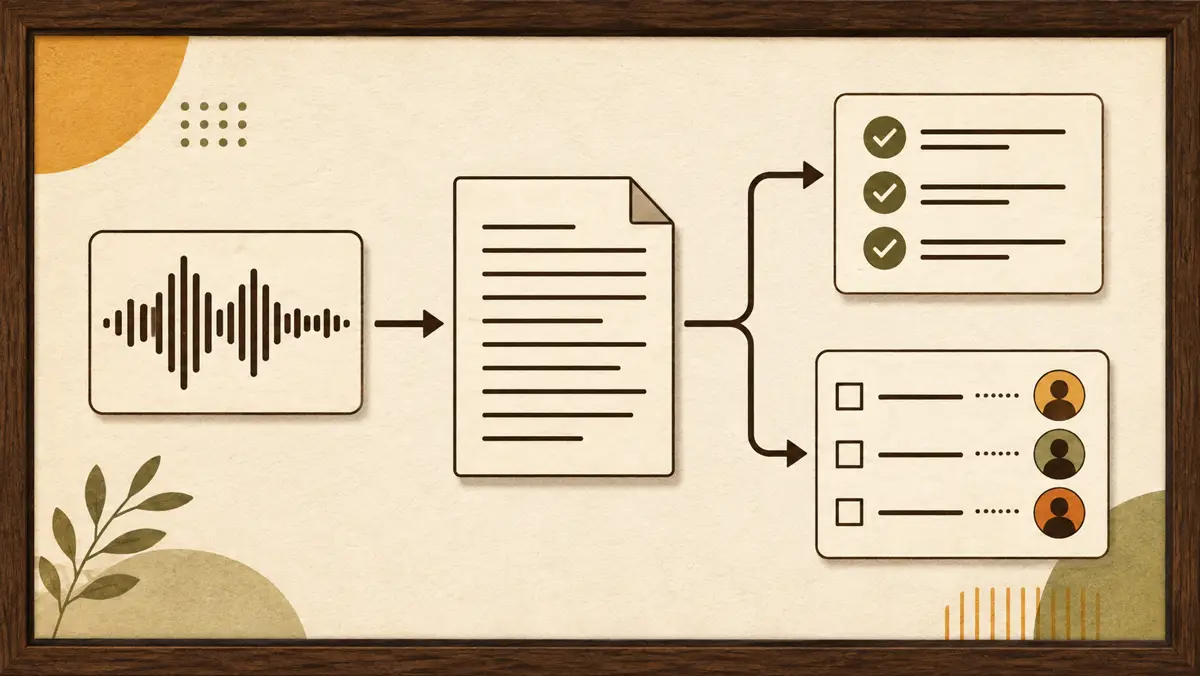
An AI notetaker converts captured audio or an uploaded recording into a transcript, notes, or both. The workflow can be ongoing through an app or bounded to a set of files through a scoped job. The useful buying question is not which label sounds smarter. It is whether you want a reusable capture workflow or a defined output from material you already have.
Otter is one example of an app vendor, checked September 3, 2026. Zapier's meeting-assistant roundup is one example of a comparison roundup, checked September 3, 2026. These sources show options, not a universal winner.
Are AI notetakers illegal?
Recording permission depends on the law and consent that apply to the call (RCFP recording guide). U.S. federal law generally permits recording with the consent of at least one party, while some states require all parties to consent (RCFP recording guide). Interstate calls can create uncertainty about which law applies (RCFP recording guide). Check the law that applies to your call before recording (RCFP recording guide). The RCFP guide does not replace legal advice from a lawyer (RCFP recording guide).
Use this consent checklist before capture:
- Identify the law that applies to the call before recording (RCFP recording guide).
- Tell every participant that you plan to record and obtain the consent required by the applicable law (RCFP recording guide).
- For an interstate call, account for uncertainty about which state's law applies (RCFP recording guide).
Is an AI note taker safe, and what are the risks?
No category-wide answer can establish safety. Review the specific tool, the meeting, and your data requirements. A buyer review should cover these points:
- Recording consent. Confirm the law and consent that apply before recording (RCFP recording guide).
- Data terms. Read the vendor's current privacy, retention, and deletion terms for the input you plan to provide.
- Access and sharing. Inspect who can open the recording, transcript, and notes. Review the sharing settings before use.
- Output review. Check names, decisions, owners, dates, unresolved questions, and ambiguous passages before using the notes.
A scoped job does not remove these checks. It changes the workflow from ongoing capture to defined input and output. Pitstop confirms fit before acceptance for its Call Notes job (Pitstop Call Notes).
Which AI note taker is the best?
There is no universal best AI note taker. Start with the workflow shape. An app fits reusable, ongoing capture. A scoped job fits a bounded backlog or one-off output. Then compare required input, delivered output, operator involvement, and fit.
Use vendor pages for current product details. Otter was available as an app-vendor example when checked September 3, 2026. Zapier's meeting-assistant roundup was available as a comparison roundup when checked September 3, 2026.
Use this buyer checklist:
- Choose ongoing capture or a bounded set of files.
- Confirm the required input before selecting an option.
- Write down the output you need before comparing it with the offered output.
- Decide who will operate the workflow and review the result.
- Check fit against your meeting type and recording-consent requirements (RCFP recording guide).
How much does an AI note taker cost?
Check each app vendor's current pricing page for plan details and limits. For a scoped Pitstop request, use the request page instead of relying on a price quoted elsewhere. Request a scoped AI job.
Are AI notetakers worth it?
An AI notetaker is worth considering when its workflow matches your job. Choose reusable capture if you want an ongoing app workflow. Choose a scoped job if the work is a bounded backlog or one-off output. Judge either option by the input it accepts, the output it delivers, the operator work it requires, and its fit for the meeting.
AI notetaker app vs. one scoped call-notes job
The two options receive the same test below. The table compares workflow shape, input, output, operator involvement, and fit.
| Decision point | Notetaker app | One scoped call-notes job |
|---|---|---|
| Workflow shape | Reusable, ongoing capture workflow | One accepted request with a defined scope (Pitstop Call Notes) |
| Required input | Audio captured by or supplied to the selected app | Meeting recording or transcript (Pitstop Call Notes) |
| Delivered output | The transcript or notes defined by the selected app | Concise summary, decisions, dated action items with owners, unresolved questions, and ambiguity flags (Pitstop Call Notes) |
| Operator involvement | Operate the app and review its output | Submit the request and input after fit confirmation, then review the delivered output (Pitstop Call Notes) |
| Fit | Reusable capture across ongoing meetings | Bounded backlog or one-off output, subject to fit confirmation before acceptance (Pitstop Call Notes) |
Pitstop Call Notes delivers the finished output and run receipt within one business day (Pitstop Call Notes). That delivery term describes the scoped service. It does not rank either workflow.
What about in-person meetings?
An AI notetaker for in-person meetings needs audio captured in the room or a transcript produced from that audio. Recording permission still depends on the law and consent that apply to the meeting (RCFP recording guide).
If you want an app, confirm that it supports the in-person input you plan to use. If you already have a permitted recording or transcript, Pitstop lists either one as accepted input for a scoped Call Notes request (Pitstop Call Notes).
Before an in-person meeting, check these items:
- Check the law that applies before recording (RCFP recording guide).
- Tell participants that you plan to record and obtain the consent required by the applicable law (RCFP recording guide).
- Confirm that the app accepts your planned in-person recording method.
- Check speaker labels, decisions, owners, and ambiguity before using the notes.
FAQ: ai notetaker
Are AI notetakers illegal? Recording permission depends on the law and consent that apply to the call (RCFP recording guide). U.S. federal law generally permits recording with the consent of at least one party, while some states require all parties to consent (RCFP recording guide). Interstate calls can create uncertainty about which law applies (RCFP recording guide). Check the law that applies to your call before recording (RCFP recording guide). The RCFP guide does not replace legal advice from a lawyer (RCFP recording guide).
What are the risks of AI notetakers? Review recording consent (RCFP recording guide), the vendor's data and retention terms, sharing settings, access controls, and the output before use. These checks apply to the specific app and meeting. Do not treat a category label as proof that a tool is safe for your data.
What is the safest AI note taker? There is no universally safest AI note taker. Compare each option's current data terms, retention controls, access controls, sharing settings, and required input against your rules. Recording permission still depends on the law and consent that apply to the call (RCFP recording guide).
What's the best free AI note taker app? There is no universal winner. Otter is one app-vendor example, checked September 3, 2026. Zapier publishes a meeting-assistant comparison roundup, checked September 3, 2026. Check current vendor pricing pages for plan details and limits before choosing.
Do I need an AI notetaker app for a one-off batch of recordings? No. Pitstop Call Notes accepts a meeting recording or transcript (Pitstop Call Notes page). After fit confirmation and acceptance, it delivers a concise summary, decisions, dated action items with owners, unresolved questions, and ambiguity flags (Pitstop Call Notes page). Pitstop delivers the finished output and run receipt within one business day (Pitstop Call Notes page).
The same app-or-scoped-job decision applies to other bounded work. Compare two contract versions with the document comparison guide, or evaluate a spreadsheet backlog with the data cleaning guide. For call notes, read the Call Notes service page.
Have a bounded recording backlog or one-off output? Request a scoped AI job.
. .
Written by Tileo, operator of Pitstop.