ChatGPT for consultants: an operating guide for client-safe agent work
By Loïc Guyon, operator of Pitstop · Updated · 8 min read
On this page
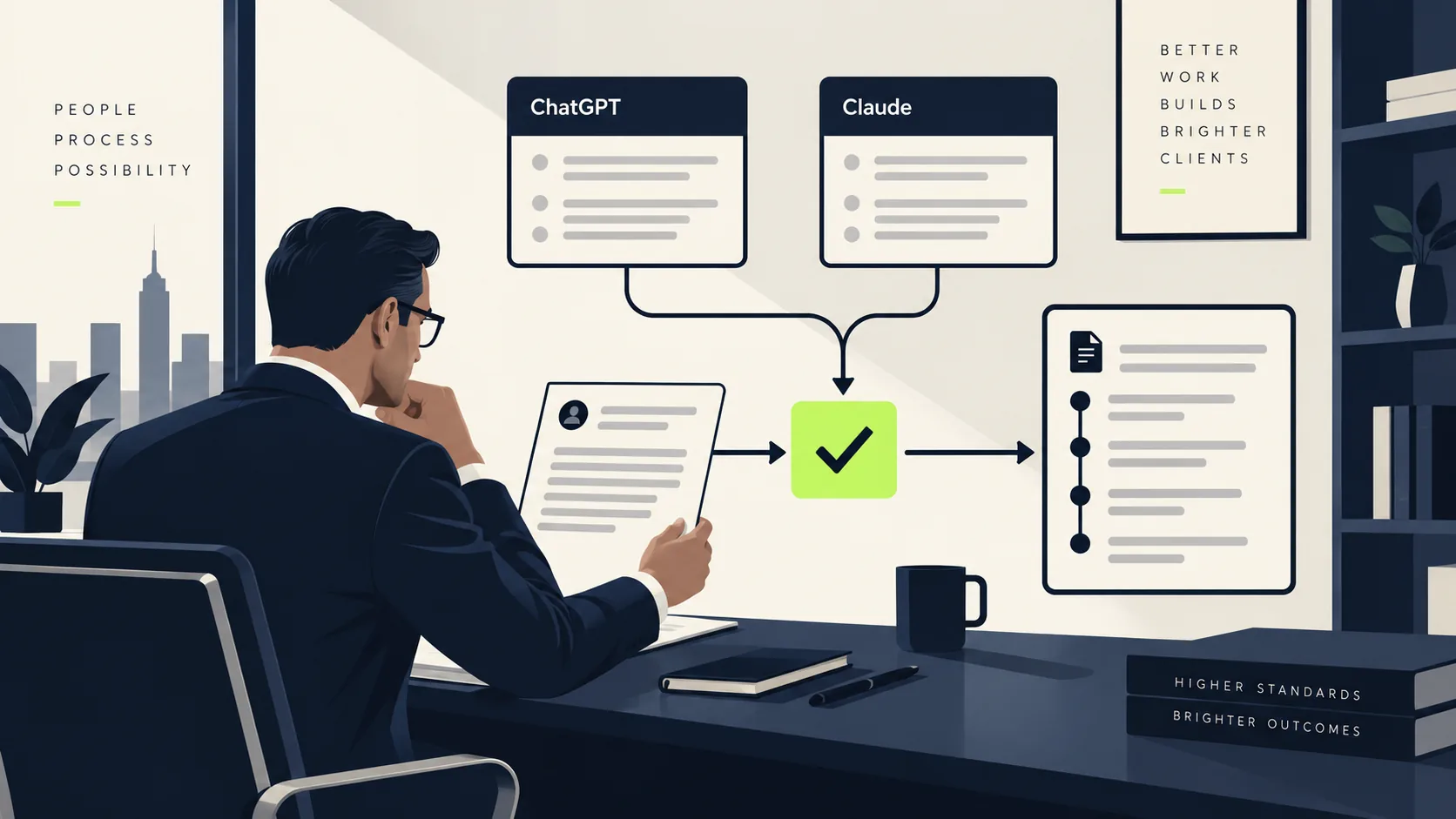
ChatGPT or Claude should not become the operating system of a consulting firm. A partner or operations lead should use it as an agent interface while keeping mandates, projects, clients, meetings, content, knowledge, and finance in a shared workspace. Start with one bounded workflow. Specify what the agent may read, what it may prepare, and where a person must decide. Connect the agent through MCP, test it on internal work, and cap every external action at “Ask first.” Before any client email, proposal, candidate message, or published text leaves the firm, a person approves the exact text. The journal then records the request and the decision. That model gives a 5–50 person firm a practical division of labor: the agent prepares and requests; the team reviews, approves, and remains accountable.
What operating model should a consulting firm use for ChatGPT or Claude?
The useful distinction is preparation versus authority. An agent can gather permitted context, structure a brief, draft an artifact, and request a decision. A person remains responsible for the judgment and for the exact words sent outside the firm.
Keep the firm's operating records in a shared workspace: mandates and projects, clients and CRM, network, meetings and preparation briefs, content, knowledge, and finance. Treat ChatGPT or Claude as an interface to that workspace, with a defined mandate for each agent. Pitstop is positioned as the workspace where teams and AI agents run the firm together, rather than as a replacement for the firm's operating discipline.
MCP is the connection layer in this model. OpenAI documents MCP servers for plugins, deep research, and API integrations in its developer documentation. Anthropic documents how Claude Code connects to tools through MCP, including remote HTTP servers. Those references establish the connection mechanism. They do not decide what an agent should be allowed to read or do inside a consulting firm. The firm must make those decisions.
A workable division of responsibility is:
- The partner defines the client boundary and names the accountable reviewer.
- The operations lead defines the workflow, permitted sources, and evidence to retain.
- The agent reads only approved material, prepares the requested artifact, and asks before any external action.
- The reviewer checks the sources, judgment, recipient, and exact outbound text.
- The journal records the request and decision so the team can inspect what happened.
This is the central rule: agents ask before anything leaves; a person approves the exact text; the journal shows any gap.
How should a firm set up its first agent workflow?
Choose one bounded consulting workflow with a clear input, artifact, and reviewer. An internal meeting brief gives the agent a mandate that a colleague can read and test.
Use this setup sequence:
- Choose one bounded workflow. Name the event that starts it, the internal artifact it should produce, and the person who reviews it. For example: prepare an internal client-meeting brief from an approved project record and selected meeting notes.
- Decide what the agent may read. List the specific workspace areas or records required for the task. Do not turn access to one brief into permission to inspect every client, financial record, or knowledge item.
- Connect through MCP. Use the connection to expose the permitted tools and records. For a remote MCP connection in Pitstop, OAuth is used. The agent should receive the smallest useful set of capabilities for the chosen workflow.
- Assign autonomy. Pitstop applies autonomy from L0 to L4 per agent, and external actions are capped at “Ask first.” Pick the level for this agent's mandate, rather than adopting one firm-wide setting for unrelated work.
- Test on internal work. Give the agent an approved example and inspect the sources it used, the artifact it produced, and the actions it requested. Correct the brief or access boundary before involving outbound work.
- Require exact-text approval for anything outbound. The reviewer must see the recipient, channel, and complete proposed message. Approval is bound to the exact content fingerprint; changing one character invalidates it.
- Review the journal. The hash-chained journal records requests and decisions and can be verified or exported. Use it to compare the written mandate with the agent's actual requests.
The setup is complete when another partner can answer: What could the agent read? What could it do without asking? Which exact outbound content did a person approve?
Which decisions need an explicit rule and inspectable evidence?
Each rule needs evidence. Define the decision, the starting rule, and the object a reviewer can inspect.
| Decision | Safe starting rule | Evidence to inspect |
|---|---|---|
| Workflow | One named internal workflow with a defined start and artifact | Workflow brief and example output |
| Read access | Only the records named for that workflow | Requested records and access configuration |
| Permitted action | Read and draft internally; ask before any external action | Agent mandate and action request |
| Autonomy | Set per agent for its stated mandate | Assigned L0–L4 level and requested actions |
| Reviewer | One accountable person or role | Reviewer named in the brief |
| Outbound content | A person approves the complete recipient, channel, and exact text | Approval request and exact content fingerprint |
| Changed draft | Any character change requires a new approval | New fingerprint and new decision |
| Oversight | Inspect requests and decisions after the test | Verifiable or exported journal |
How should consultants write prompts as bounded briefs?
An effective consulting prompt is a bounded brief, not a persona incantation. It tells the agent what outcome to prepare, which material it may use, what action is permitted, what artifact is expected, who reviews it, and what must happen before anything leaves the firm.
Use these six fields:
- Objective: State the decision or preparation task, such as “prepare the partner for the client steering meeting.”
- Source material: Name the approved project record, meeting notes, client record, or knowledge items the agent may read.
- Permitted action: Say whether the agent may read, summarize, compare, or draft. State that external action requires a request.
- Expected artifact: Define the output, such as a one-page internal brief with open questions, cited source records, and a draft agenda.
- Reviewer: Name the person or role responsible for checking the work.
- Outbound rule: Require approval of the recipient, channel, and exact text before an external message or publication.
For example:
Objective: Prepare the partner for the Acme steering meeting. Source material: the approved Acme project record and the three meeting notes named below. Permitted action: read those records and draft internally; do not take an external action. Expected artifact: an internal brief containing decisions due, unresolved questions, source references, and a proposed agenda. Reviewer: engagement partner. Outbound rule: if an email or other external message is proposed, request approval for the complete recipient, channel, and exact text.
The agent's mandate and workspace controls hold the standing rules. The brief supplies the task-specific objective, inputs, artifact, and reviewer. Together they make the work reviewable through the decision boundary: who checks the answer, what evidence they see, and whether it remains internal or becomes a proposed external communication.
What should ChatGPT or Claude never send without exact-text approval?
An agent should not send, publish, or submit external content unless a person has approved the exact text, recipient, and channel. This includes:
- Client emails, follow-ups, and meeting recaps.
- Candidate or network outreach.
- Proposals, statements of work, and commercial responses.
- Articles, social posts, website copy, and other published content.
- Any other message or submission addressed outside the firm.
The agent may prepare a draft and request approval. It may read the status of that request, but it cannot approve its own request. In Pitstop, the approval inbox works on laptop or phone. Approval is tied to the exact content fingerprint, so a one-character change invalidates the prior approval.
This is an exact-content rule, not a general blessing for a campaign, client, or conversation. If the recipient changes, the channel changes, or the text changes, the reviewer needs the actual outbound object in front of them. The human-in-the-loop operating model explains this boundary in more detail.
Pitstop does not need to be described as the sender or the blocker. The accurate operating language is simpler: external actions are capped at “Ask first”; the agent requests; a person approves the exact text; the journal records the request and decision.
How should a partner review the agent's journal?
Review the journal against the written mandate, not against whether the final draft happened to look good. A polished artifact can still come from the wrong sources or from an action the agent was not authorized to take.
Inspect five objects:
- The request: What was the agent trying to do?
- The source boundary: Which records did it ask to read?
- The proposed action: Was it internal preparation or an external action?
- The decision: Who approved or declined it, and what exact content fingerprint was attached?
- The result: Does the produced artifact match the objective and permitted action in the brief?
Because the journal is hash-chained, it can be verified or exported. Use it to find gaps between policy and behavior, then correct the mandate, source list, reviewer, or outbound rule before expanding the agent's work.
How can a firm roll this model out across a team?
Turn the first tested workflow into a reference example. Give the team the workflow brief, the access rule, the prompt structure, one accepted internal artifact, and the journal review checklist. The goal is consistency that can be inspected, not a collection of personal prompting tricks.
Before adding another workflow, require its owner to name:
- The consulting task and expected artifact.
- The records the agent may read.
- The actions it may take without asking.
- The autonomy level assigned to that agent.
- The accountable reviewer.
- The exact-text approval rule for any outbound result.
- The journal evidence the operations lead will inspect.
What is the best AI tool for a consulting business?
There is no single answer independent of the firm's workflow. Start with the operating decision: which records the agent needs, which artifact it must prepare, what it may do without asking, and who approves external text. Then choose an interface that can work within those boundaries.
OpenAI documents MCP servers for plugins, deep research, and API integrations, while Anthropic documents MCP tool connections for Claude Code. Confirm the relevant product setup for your firm without assuming that documentation for one product or integration applies to every plan.
What are effective ChatGPT prompts for consultants?
Effective prompts define a bounded brief. Include the objective, approved source material, permitted action, expected artifact, reviewer, and outbound rule. A useful prompt makes it possible to inspect both the answer and the agent's authority.
For example, ask for an internal meeting brief from named records, require source references and open questions, identify the engagement partner as reviewer, and prohibit external action unless the complete recipient, channel, and exact text are submitted for approval. The same structure applies when using Claude for consultants.
What should a consulting firm's AI approval policy say?
It should state that agents ask before anything leaves; a person approves the exact text; the journal shows any gap. Define read access and autonomy per agent, cap external actions at “Ask first,” and require a new decision whenever approved content changes. The agent may request approval and read its status, but it cannot approve.
The policy becomes operational only when the firm can inspect the brief, access boundary, action request, exact content fingerprint, reviewer decision, and journal record.
Written by Loïc Guyon (Tileo), operator of Pitstop.