Agentic AI tools list: choose the right category
What are the best agentic AI tools? The best fit depends on what your team wants to own. Choose n8n when you want its documented AI Agent node connected to a chat model and tools (n8n documentation). Choose LangGraph, CrewAI, or the OpenAI Agents SDK when your team wants to structure agent work in code (LangGraph documentation, CrewAI documentation, and OpenAI Agents SDK documentation). Consider a bounded job service when you want a named artifact with explicit input, output and limits (Pitstop profile). This is a category-first agentic AI tools list, not a universal ranking.
Compare products only after you decide whether your team wants to own the workflow or receive the artifact.
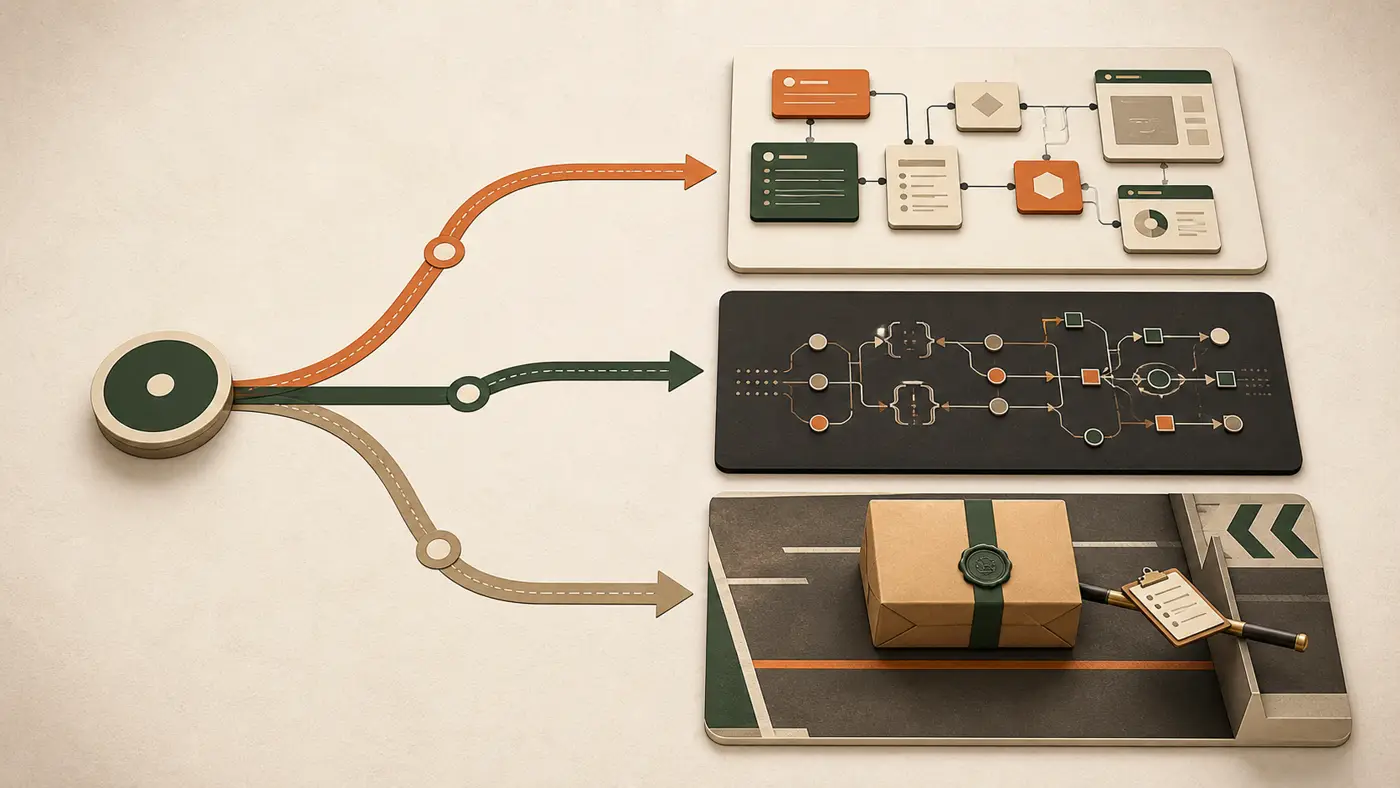
Start with the ownership question: do you want to own a node-based setup, own workflow code, or receive a bounded artifact?
What counts as an agentic AI tool?
For an ops buyer, the useful definition starts with the work boundary, not the label. The term can cover workflow products, frameworks that let a team define an agent workflow, and services that deliver a bounded result. Those are different purchases even when each is described as agentic.
A category-first view keeps the decision tied to what your team will own:
- Workflow product: n8n documents an AI Agent node that lets you build an AI agent in n8n. Connect a chat model and one or more tools, and the agent decides which tools to call to complete a task (n8n documentation).
- Code framework or SDK: your team defines the workflow in code. LangGraph is a low-level orchestration framework and runtime for building, managing, and deploying long-running, stateful agents (LangGraph documentation).
- Bounded job service: the request is framed by an explicit input, output and limits, as Pitstop describes on its profile and in its AI agent marketplace guide.
Directories and ranked lists serve a different purpose. They help a reader discover names. Gumloop, for example, publishes a list titled “8 best agentic AI tools I’m using in 2026 (free + paid)” (Gumloop list). A buyer still needs a category test after reading a list.
Which agentic AI tool category fits your work?
Choose by the part of the workflow your team wants to own. The right category follows from that boundary.
- You want a documented agent node connected to a model and tools: consider a workflow product. n8n documents an AI Agent node that lets you build an AI agent in n8n. Connect a chat model and one or more tools, and the agent decides which tools to call to complete a task (n8n documentation).
- You need to define state and control: consider a code framework or SDK. A code team can consider LangGraph when low-level control over long-running, stateful agents fits the requirement. LangGraph is a low-level orchestration framework and runtime for building, managing, and deploying long-running, stateful agents (LangGraph documentation), while the OpenAI Agents SDK names agents, handoffs, guardrails and tracing as core concepts (OpenAI Agents SDK documentation).
- You need a named artifact: consider a bounded job service when explicit input, output and limits matter more than owning the workflow. Pitstop uses that framing and describes a scoped-request path (Pitstop profile; marketplace guide).
This choice is separate from a broader business automation tools decision. That broader decision may include tools that are not presented as agentic. It is also separate from choosing business process automation services, where the service boundary is the main subject.
A product category tells you what your team must own after selection.
What are the best agentic AI tools?
The best choice depends on the structure your team needs, not a universal rank. The table gives every option the same treatment. “Documented structure” is a sourced fact. “Buyer-fit opinion” is an editorial judgment based only on that fact.
| Option | Category | Documented structure | Buyer-fit opinion |
|---|---|---|---|
| n8n | Workflow product | The AI Agent node lets you build an AI agent in n8n. Connect a chat model and one or more tools, and the agent decides which tools to call to complete a task (source). | Opinion: consider it when a node-based setup fits the requirement. |
| LangGraph | Code framework | A low-level orchestration framework and runtime for building, managing, and deploying long-running, stateful agents (source). | Opinion: a code team can consider it when low-level control over long-running, stateful agents fits the requirement. |
| CrewAI | Code framework | Two documented concepts called Crews and Flows for structuring agent work (source). | Opinion: consider it when those two named structures match how the team wants to frame the work. |
| OpenAI Agents SDK | SDK | Agents, handoffs, guardrails and tracing are named as core SDK concepts (source). | Opinion: consider it when the team wants to work directly with those concepts in an SDK. |
| Pitstop | Bounded job service | Jobs framed around explicit input, output and limits, with a scoped-request path (source; source). | Opinion: consider it when a named artifact matters more than owning the workflow. |
The table is not a scorecard. It does not rank one structure above another. It shows what each option asks the buyer to engage with.
When is a bounded AI job a better fit than an agent platform?
A bounded job is the better fit when the artifact matters more than ownership of the workflow. The buyer should be able to name what goes in, what comes out and where the job stops. Pitstop frames its jobs around explicit input, output and limits, and its public path is a scoped request (Pitstop profile; marketplace guide).
That fit is narrow by design. It works for a buyer who wants:
- A named input stated before the request.
- A named output artifact stated before the request.
- Explicit limits on what the job includes.
- A scoped-request path instead of ownership of the underlying workflow (Pitstop profile).
A platform or framework fits a different goal. Choose it when owning the workflow is part of the requirement. A bounded job does not replace that need. It answers a smaller request: produce the named artifact within the stated limits.
Use a bounded job only when the deliverable can be named without turning the request into a permanent agent platform.
What should you verify before adopting an agentic AI tool?
Verify the category, the work boundary and the artifact before you commit to a tool. A short acceptance checklist keeps the review tied to the buyer’s actual need.
- Category: Is this a workflow product, a code framework or SDK, or a bounded job service?
- Ownership: Does your team want a documented agent node connected to a model and tools, need to define state and control, or want to receive an artifact?
- Structure: Does the product’s documented structure match that choice? For example, n8n documents an AI Agent node that connects to a chat model and one or more tools (source), and LangGraph is a low-level orchestration framework and runtime for building, managing, and deploying long-running, stateful agents (source).
- Input: Can the required input be named in advance?
- Output: Can the expected artifact be named in advance?
- Limits: Can the included and excluded work be stated plainly?
If the team cannot answer the ownership question, pause the product comparison. A long list will not resolve an undefined boundary. If the artifact and limits are already clear, a scoped intake may be enough to frame the next decision.
Have a named artifact and a fixed boundary?
Is ChatGPT itself an agentic AI tool?
The answer depends on what the speaker means by “agentic AI tool.” At category level, a chat interface and an agent workflow are not the same buying category. The useful buyer question is not whether a broad label applies. It is whether the option exposes the workflow, lets your team define state and control, or returns a bounded artifact.
No claim about a current ChatGPT mode is needed for that decision. Assess the work boundary you need, then compare products within the matching category.
FAQ about agentic AI tools
These short answers restate the category-first decision model.
What are the main categories of agentic AI tools?
For this buying decision, the useful categories are workflow products, code frameworks and SDKs, and bounded job services. The categories differ in how much workflow the buyer must define and own.
Should an ops team choose a workflow product or a code framework?
Choose a workflow product when you want a documented agent node connected to a chat model and tools. Choose a code framework when your team needs to define state and control in code.
When does a bounded AI job fit?
A bounded AI job fits when you want a named artifact and explicit limits, but do not want to own the underlying workflow.
Is ChatGPT an agentic AI tool?
The label depends on the category being discussed. A chat interface and an agent workflow are not the same buying category, so assess the workflow, control and output you need instead of relying on the label alone.