Product Management AI Tools: A Job-First Guide
Use a product management AI tool when the work needs a shared system that stays active. This could be a roadmap, feedback store, analytics space, or project flow. Use a bounded AI job when the source set is closed and the output is named. Acceptance can then be checked at handoff. Product School lists assistants for text, data work, launch plans, product documents, and prototypes. Motion groups tools around project flows, user analytics, feedback, meeting notes, and roadmaps. Product School Motion Choose from the job first. Then define the inputs, artifact, exceptions, reviewer, and acceptance proof before selecting a business automation tool or a run.
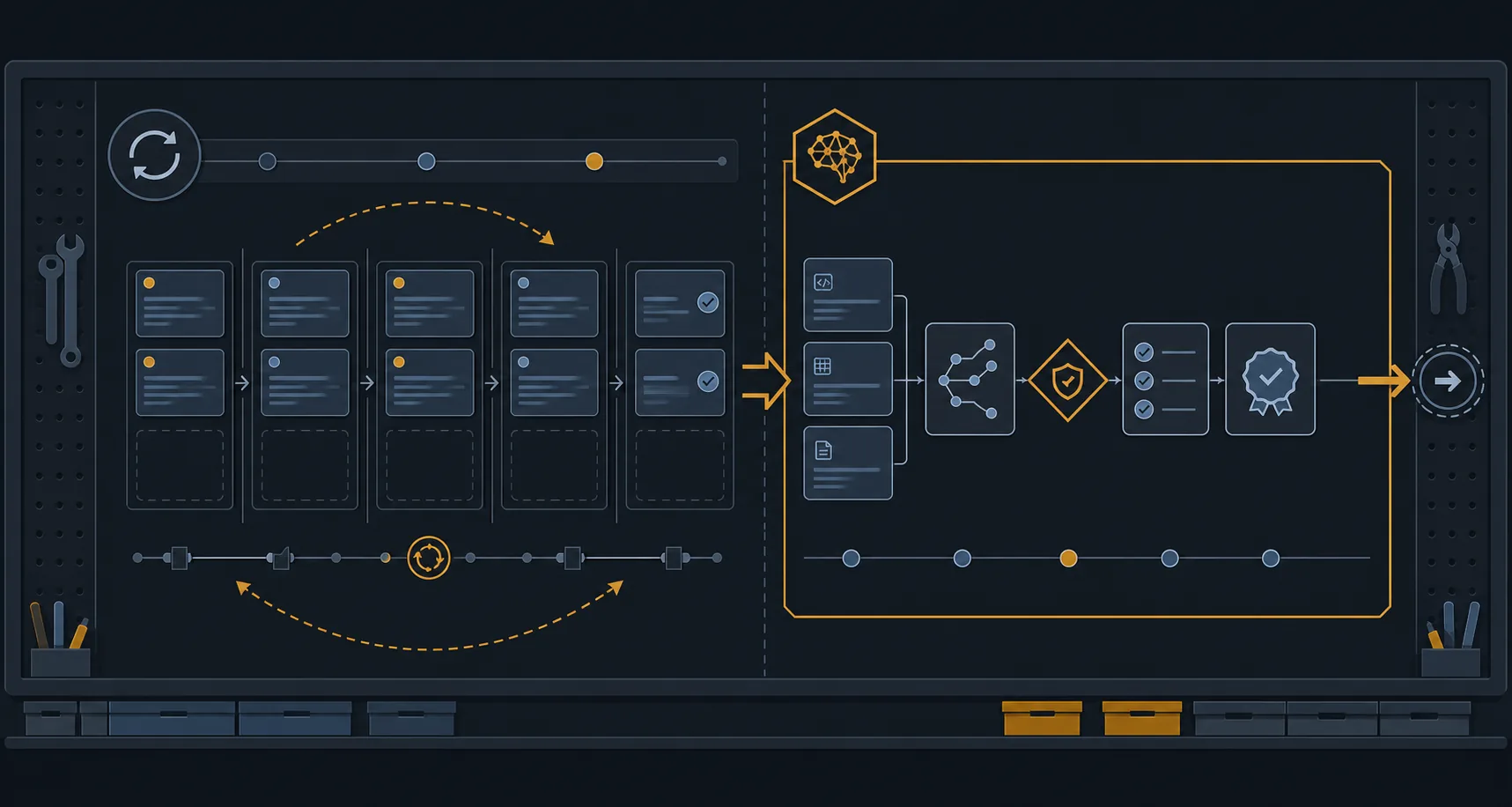
A product workflow can remain inside a recurring platform or close as one finite job with a checked artifact.
What AI tools should a product manager use?
Start with the PM work, not a ranked list. The current guides divide the market into distinct jobs. Product School says ChatGPT can support summarizing, editing, text creation, idea prioritization, data organization, reports, launch plans, release notes, and user communications. It describes Notion AI for document organization, action items, proofreading, and text summaries. These are publisher descriptions of tool uses, not Pitstop tests. Product School
Dedicated platforms cover narrow product flows. Motion describes Pendo for user analytics and in-app messages, Zeda.io for product feedback, Otter for meeting notes, and Productboard for customer roadmaps. Motion says its own product schedules tasks from team availability, due dates, and calendars. Those claims come from Motion's review. They include a vendor describing its own product. Motion
Stackby frames the selection around customer feedback synthesis, roadmaps, prioritization, competitive intelligence, and cross-functional alignment. It also says a general writing assistant is not the same as a purpose-built research tool. Stackby sells a platform in this market, so treat its product-specific statements as vendor claims. Stackby
CPO Club describes this category as tools that automate backlog updates and surface user insights while aligning teams around clear priorities. That is a useful scope for the category. It is not a reason to accept a publication's ordering as your buying decision. CPO Club
A practical shortlist can therefore use work categories:
- General assistant: drafting, summarizing, and idea work described by Product School. Source
- Research and feedback platform: connected evidence, themes, and feedback records described by Stackby and Motion. Stackby Motion
- Roadmap or project platform: shared priorities, tasks, schedules, and roadmap state described by CPO Club and Motion. CPO Club Motion
- Bounded AI job: a closed source set, named artifact, stop limit, and written acceptance checks. Pitstop's scoping guide uses those fields to separate one run from a platform decision. Business automation tools guide
Which PM tasks are bounded enough for a scoped AI job?
A PM task is bounded when the buyer can close the input set and name the returned artifact before work starts. The brief also needs a clear stop limit and a review rule. Pitstop's guide to automated document processing uses the same split. It asks for exact sources, included material, target fields, an output schema, source links, and acceptance checks.
That structure can fit PM work named by the source guides. Product School describes text summaries and edits, product data work, reports, launch material, and product documents. Motion describes meeting notes and summaries. Stackby describes feedback review and roadmap documents. A bounded request takes one defined set from one of those groups. It asks for one output that a person can check. Product School Motion Stackby
Hypothetical scoping examples of bounded PM requests include:
- Hypothetical scoping example: A closed set of interview transcripts returned as a theme table with a source reference for each included item.
- Hypothetical scoping example: A named set of product notes returned in an agreed PRD template, with blanks marked for review.
- A meeting recording returned as a summary, decision list, action items, unresolved questions, and flags for unclear speakers or commitments. That input and output are stated on Pitstop's call notes service page.
- Hypothetical scoping example: A closed feedback export returned in a defined schema, with excluded records and review-needed items labeled.
These are hypothetical scoping examples. They are not claims that Pitstop currently offers those jobs.
| PM work | Use a tool or platform | Use a bounded AI job | Acceptance evidence for the job |
|---|---|---|---|
| Customer feedback | The repository must keep receiving and organizing feedback while connecting it to the product workflow. Stackby | One closed export needs a named theme or evidence artifact. Scoped job guide | Every accepted item follows the schema and carries the required source reference. Acceptance checklist |
| Roadmap work | The team needs shared priorities, workflow state, permissions, and ongoing updates. Motion Platform guide | One defined set of notes needs conversion into an agreed roadmap input format. Scoped job guide | Required fields must be present and exceptions marked. The handoff must also match the template. Acceptance checklist |
| Product documents | Documents need organization, action items, proofreading, and summaries. Product School | A closed source set needs one specified document artifact. Scoped job guide | The agreed sections, labels, source notes, and review flags are present. Acceptance checklist |
| Meeting records | Calls must enter a continuing recording and team knowledge workflow. Motion | A named recording or transcript set needs one defined notes package. Call notes service | The required summary, decisions, actions, questions, and ambiguity flags are present. Call notes service |
Have a closed input set and a named artifact?
When should a team buy a platform instead?
Buy a platform when the product work is a continuing system, not a finite handoff. A roadmap needs current state. A feedback repository needs continuing intake. A product analytics workspace needs connected product data. A project workflow needs owners, permissions, and updates. Motion and Stackby describe tools built around those continuing workflows. Motion Stackby
Use a platform when the team needs:
- Shared records that remain active after one artifact is delivered. Stackby
- Connections to product data, feedback sources, calendars, or team workflows. Motion Stackby
- A recurring process with a named operator for monitoring and exceptions. Platform, build, or scoped job guide
These needs change what you are buying. The team takes ownership of a working system. That includes its setup, access, data, and errors. The platform, build, or scoped job guide says to name the cadence and owner in the brief. It also splits a set process from a single batch.
Do not use a one-off job to disguise a platform requirement. Scope the platform and its owner when new records must keep arriving. The same applies when the result must remain synchronized with product systems or several people must edit shared state. If the source set closes and the work ends with an accepted file, keep the request bounded.
What inputs and acceptance criteria should a PM define?
Write the brief so a reviewer can check the return without making up a new rule after delivery. Pitstop's scope guides split inputs from acceptance. They name the process, exact sources, artifact, error rules, human review, owner, and stop limit. They also call for the output schema and source-link format. Business automation brief Acceptance checklist
Input checklist
- Process name: name one PM job.
- Source manifest: list the files, exports, recordings, pages, sheets, or sections in scope.
- Included and excluded material: state the boundary before the run.
- Target artifact: provide the document type, table, fields, labels, or template to return.
- Source-reference format: state how a returned item should point to its file, page, row, section, or timestamp when traceability is required.
- Exception rule: define the label for blank, unreadable, uncertain, or review-needed content.
- Handoff format: provide the file type, headers, column order, labels, and naming rule.
- Stop limit: state what the request does not include.
Acceptance checklist
- Every applicable record contains the required fields or sections.
- Each target value follows the agreed format.
- Blank, unreadable, uncertain, and review-needed content uses the agreed label.
- Each item includes the required source reference.
- The artifact uses the agreed headers, order, labels, file type, and file name.
- The named reviewer records acceptance only after checking the artifact.
These checks do not claim that an AI output is accurate by default. They define observable conditions for one delivery. The reviewer still checks the returned artifact against the source and the written rules.
How should human review and handoff work?
Human review should be part of the scope. A final note that says “check the output” is not enough. Name the reviewer and the proof they will inspect. Name the labels that block acceptance and the file that records the choice. The Medium account in this SERP describes a flow that pauses for human approval before it goes on. Treat that as the author's report, not a result checked by Pitstop. Medium
A clean handoff can follow this sequence:
- Receive the artifact. Confirm that the expected file and manifest are present. Automated document processing checklist
- Check structure. Inspect required sections, fields, labels, formats, and naming. Acceptance checklist
- Check evidence. Follow the required source references back to the supplied material. Acceptance checklist
- Resolve exceptions. Review every item marked blank, uncertain, unreadable, or review-needed. Acceptance checklist
- Record acceptance. The named reviewer records acceptance after checking the artifact. Automated document processing checklist
The handoff should not transfer an unstated decision to the AI. A theme table can show evidence, while a document can follow a template. Meeting notes can list decisions and unclear commitments without taking the product decision from the PM.
FAQ about product management AI tools
What is AI used for in product management?
Published guides describe uses across writing, research, feedback, analytics, roadmaps, project workflows, meeting transcripts, and prototypes. Product School and Motion document those categories. The PM still defines the decision and reviews the evidence. Product School Motion
Can ChatGPT replace a product management platform?
Product School describes ChatGPT as supporting summarizing, editing, text creation, idea prioritization, data organization, and launch materials. Stackby distinguishes a general writing assistant from a purpose-built research tool. A platform also holds the shared state, integrations, and recurring records of a team workflow. Product School Stackby
What makes a PM task suitable for a bounded AI job?
The source set is closed and the requested artifact is named. The scope also has a stop limit, with written checks deciding whether the handoff is accepted. If the work must keep receiving data and maintaining shared state, it belongs in a platform brief.
How should a PM check AI output?
Check the artifact against the agreed schema, required fields, source references, exception labels, and file naming. Review the marked exceptions. Record acceptance only after the defined checks pass.
Turn one PM task into a closed brief with an inspectable handoff.
Written by Tileo, operator of Pitstop.